Home › Best Supplements › What is the best natural remedy for a sore throat?
RankingsWhat is the best natural remedy for a sore throat?
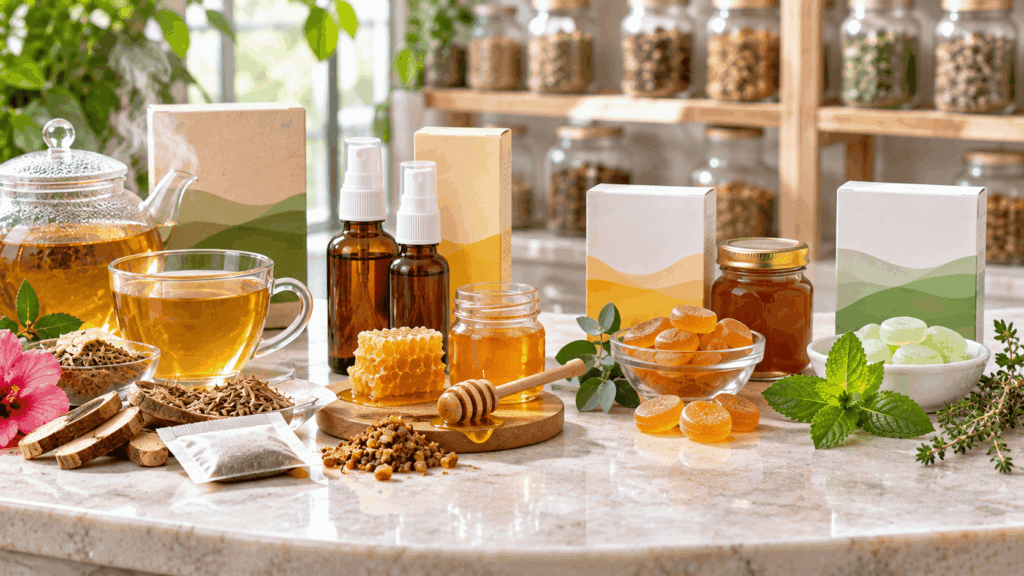
A scratchy, burning throat can derail your whole day, and reaching for a natural remedy is often the first instinct. The good news: several plant-based ingredients have genuine evidence behind them. The challenge is sorting the proven soothers from the marketing noise.
We evaluated five widely available natural sore throat products across four criteria – ingredients backed by research, format and ease of use, value for money and real buyer feedback – and scored each one out of 10. Every ingredient claim was checked against peer-reviewed research or regulatory records.
Below you will find our top-ranked picks, a guide to the active ingredients that actually matter, and honest notes on what each product does well and where it falls short.
After scoring five natural sore throat remedies on ingredients, format, value and buyer feedback, our top three are: Traditional Medicinals – Throat Coat Tea (8.9/10) for its research-backed blend of slippery elm and licorice root; Beekeeper's Naturals – Propolis Throat Spray (8.4/10) for targeted, on-the-go relief with bee propolis; and Wedderspoon – Organic Manuka Honey Drops (8.0/10) for a soothing honey-based lozenge with eucalyptus and propolis.
Why natural remedies can help a sore throat
Most sore throats are caused by viral infections and resolve on their own within five to seven days. According to the Mayo Clinic, antibiotics will not help a viral sore throat, which is why many people turn to natural options for symptom relief while the body heals.
Several natural ingredients have plausible mechanisms of action. Demulcents such as slippery elm bark and marshmallow root form a mucilage layer that physically coats irritated throat tissue. Honey has been shown in a Cochrane review to be potentially more effective than usual care for reducing cough frequency and severity. Menthol, derived from peppermint, is an FDA-approved cough suppressant and oral anesthetic. And bee propolis has demonstrated antimicrobial and anti-inflammatory properties in laboratory studies, though large-scale human trials remain limited.
That said, natural does not mean universally safe. Some ingredients interact with medications, and products containing bee-derived ingredients can trigger severe allergic reactions in people with bee or pollen allergies. If your sore throat lasts more than seven days, is accompanied by a high fever, or makes it difficult to swallow or breathe, see a doctor promptly.
Natural sore throat remedies work best for mild, viral sore throats. They are not a substitute for medical treatment when symptoms are severe, persistent or accompanied by fever above 101 °F (38.3 °C).
What to look for in a natural sore throat remedy
Demulcent ingredients
Demulcents are substances that form a soothing film over mucous membranes. Slippery elm bark is the best-known example and is recognized by the FDA as an oral demulcent. Marshmallow root works similarly. Look for products that list these ingredients with their amounts rather than hiding them inside a vague “proprietary blend.”
Honey or bee propolis
Honey coats the throat and a Cochrane review found it may reduce cough symptoms better than usual care, diphenhydramine or no treatment. Manuka honey, graded by its methylglyoxal (MGO) content, is a premium option but standard honey also has evidence behind it. Propolis, the resinous substance bees use to seal their hives, has shown antimicrobial properties in vitro, though clinical evidence is still emerging.
Menthol content
Menthol is the only natural-origin ingredient in this category with full FDA approval as both a cough suppressant and an oral anesthetic. It provides a cooling sensation and temporary numbing of throat pain. Products containing at least 2 mg of menthol per dose are generally considered effective.
Format that suits you
Teas deliver warmth and hydration alongside active ingredients, which is a genuine benefit since warm fluids help thin mucus. Sprays target the back of the throat directly and are convenient for on-the-go use. Lozenges dissolve slowly, giving active ingredients prolonged contact time with throat tissue. Your best format depends on when and where you need relief.
Check ingredient amounts, not just names. A product listing “slippery elm” without a milligram amount may contain too little to be effective. Transparent labeling is a good sign of a quality product.
How we scored these sore throat remedies
- Ingredients (35%) – Evidence base for key active ingredients, transparency of labeling, and amount per dose.
- Format and ease of use (25%) – Convenience, taste, portability, servings per package and how well the format delivers ingredients to the throat.
- Value (20%) – Cost per serving relative to the quantity and quality of active ingredients.
- Buyer feedback (20%) – Verified ratings and reviews from major US retailers, weighted toward volume and consistency of feedback.
For a full explanation of our testing methodology, see How we rank products.

Our ranking at a glance
| Rank | Product | Format | Score | |
|---|---|---|---|---|
| #1 | Traditional Medicinals - Throat Coat Tea | Herbal tea bags | 8.9/10 | Check price |
| #2 | Beekeeper's Naturals - Propolis Throat Spray | Throat spray | 8.4/10 | Check price |
| #3 | Wedderspoon - Organic Manuka Honey Drops | Honey drops | 8.0/10 | Check price |
| #4 | Ricola - Original Herb Drops | Cough drops | 7.6/10 | Check price |
| #5 | MaryRuth Organics - Throat Spray | Herbal spray | 7.2/10 | Check price |
Our picks reviewed
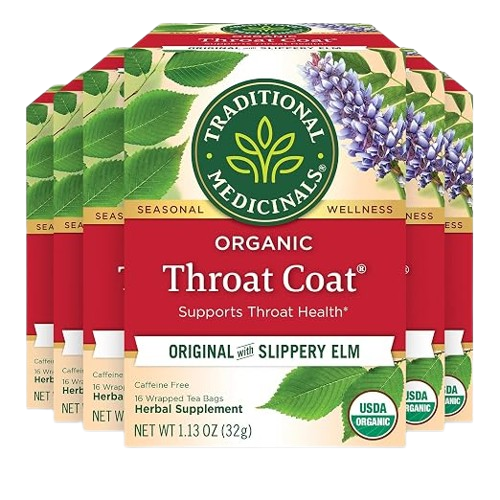
Traditional Medicinals - Throat Coat Tea
A research-backed herbal tea blending slippery elm, licorice root and marshmallow root for effective throat-coating relief.
- Slippery elm bark 80 mg
- Licorice root 760 mg
- Marshmallow root 60 mg
- 16 wrapped tea bags
- Three proven demulcent and soothing ingredients with labeled amounts
- Organic, non-GMO and caffeine-free with transparent sourcing
- Strong buyer ratings (4.7/5 across hundreds of reviews)
- Requires several minutes of steeping, so not ideal for on-the-go relief
- Contains licorice root, which may interact with some medications
- Tea format means you need access to hot water
[Why it earned this spot: form, dose versus NHS reference intake, what buyers report.]
Throat Coat has been a staple in the herbal tea category for decades, and the formula justifies its reputation. The star ingredient is slippery elm bark (80 mg), an FDA-recognized oral demulcent that forms a soothing mucilage layer over irritated throat tissue. It is supported by licorice root (760 mg), which has been studied for sore throat relief including in post-operative settings, and marshmallow root (60 mg), another traditional demulcent. Wild cherry bark, fennel and cinnamon round out the blend.
Buyer feedback is consistently positive across retailers, with a 4.7 out of 5 rating from nearly 700 reviews on Walmart. One reviewer noted it is "very soothing on the throat" (Jennifer, Walmart), while another said it "soothes the throat every time" (Chris, Walmart). The main limitation is the format: you need hot water and a few minutes of steeping time, which makes it less portable than a spray or lozenge. The tea also contains licorice root, which can raise blood pressure and interact with certain medications including diuretics and corticosteroids – check with your doctor if you take any regular medication.
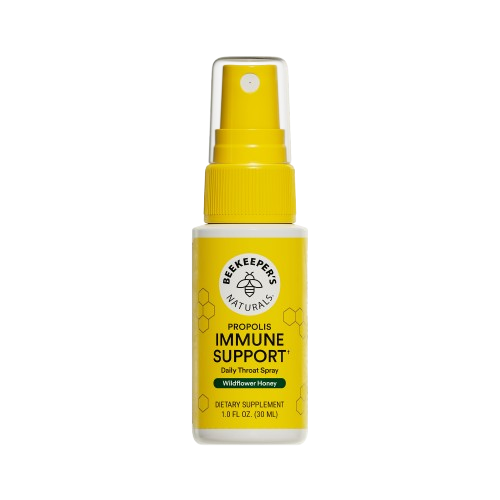
Beekeeper's Naturals - Propolis Throat Spray
A targeted propolis-based spray that delivers antimicrobial bee propolis directly to the back of the throat in seconds.
- Bee propolis extract 85 mg per serving
- Wildflower honey
- Vegetable glycerin base
- 1.06 fl oz (30 ml)
- Propolis delivers targeted antimicrobial and anti-inflammatory compounds
- Spray format hits the throat directly with no steeping or dissolving needed
- Excellent buyer ratings (4.8/5 from over 560 reviews)
- Not suitable for anyone with bee or pollen allergies
- Higher price per serving than teas or lozenges
- Limited ingredient list beyond propolis and honey
[Why it earned this spot: form, dose versus NHS reference intake, what buyers report.]
Propolis is the resinous compound bees use to protect their hives, and it contains flavonoids and phenolic acids that have shown antimicrobial and anti-inflammatory activity in laboratory studies. This spray delivers 85 mg of propolis extract per four-spray serving, combined with wildflower honey and vegetable glycerin for a smooth, slightly sweet taste. The spray format is the real advantage here: four quick sprays target the back of the throat directly, making it the most convenient option in our lineup for use at work or while traveling.
Buyers are overwhelmingly positive, with a 4.8 out of 5 rating from over 560 reviews on Vitacost, where 86% of reviewers gave it five stars. Reviewers highlight the "great quality, anti-inflammatory and antimicrobial benefits" and its "sweeter, gentler honey flavor" (Vitacost). The bottle yields roughly 60 servings, though the per-serving cost is higher than a tea bag. The most important caveat: propolis can cause severe allergic reactions in people allergic to bees, pollen or bee products. If you have any of these allergies, skip this product entirely.
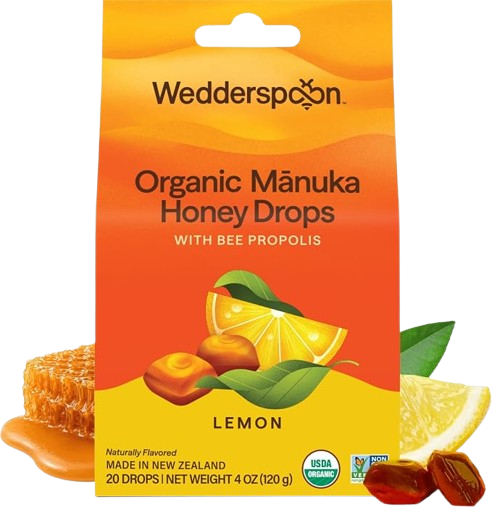
Wedderspoon - Organic Manuka Honey Drops
USDA Organic manuka honey drops with eucalyptus and propolis for slow-dissolving sore throat relief.
- Organic manuka honey (16%)
- Eucalyptus oil (0.19%)
- Menthol crystals (0.14%)
- 20 drops per pack
- Genuine manuka honey combined with eucalyptus and menthol for multi-action relief
- Individually portioned drops are easy to carry and use anywhere
- Strong buyer ratings (4.7/5 from over 900 reviews on iHerb)
- Manuka honey content is 16%, with organic cane sugar as the first ingredient
- Contains propolis, so not suitable for bee allergy sufferers
- Only 10 servings per pack at two drops per serving
[Why it earned this spot: form, dose versus NHS reference intake, what buyers report.]
These drops combine manuka honey with eucalyptus oil and menthol crystals for a multi-pronged approach. Manuka honey is prized for its methylglyoxal content, which contributes additional antibacterial activity beyond that of regular honey. The eucalyptus oil adds a cooling, clearing sensation, and the small amount of menthol provides mild numbing relief. The lozenge format allows the ingredients to coat the throat slowly as each drop dissolves.
With over 900 ratings and a 4.7 out of 5 score on iHerb, buyer sentiment is strong. The drops are USDA Organic, Non-GMO Project Verified and Kosher. However, it is worth noting that organic cane sugar is the first ingredient, with manuka honey making up 16% of the formula – so these are a sugar-based drop with manuka honey rather than a pure honey product. The pack contains 20 drops at a recommended serving of two, giving you just 10 servings. Other flavor options include ginger with echinacea and lemon with bee propolis. As with the Beekeeper's spray, the propolis content means these are unsuitable for anyone with bee allergies.
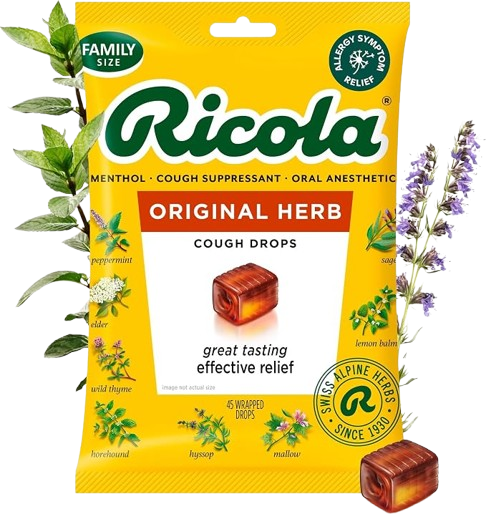
Ricola - Original Herb Drops
A Swiss-made herbal cough drop with FDA-approved menthol and a blend of ten traditional alpine herbs.
- Menthol 4.8 mg (active)
- 10-herb blend including sage, thyme and elder
- 21 drops per bag
- Swiss made
- Menthol is FDA-approved as both a cough suppressant and oral anesthetic
- Swiss heritage blend of ten herbs with a distinctive, non-medicinal taste
- Widely available, affordable and individually wrapped for portability
- Menthol is the only active ingredient with strong evidence; the herb blend is traditional rather than clinically proven
- Contains sugar and starch syrup
- Fewer verified reviews than some competitors
[Why it earned this spot: form, dose versus NHS reference intake, what buyers report.]
Ricola's Original Herb Drops take a different approach from the other products in this list. The active ingredient is menthol at 4.8 mg per drop, which is FDA-approved as both a cough suppressant and an oral anesthetic. This is not a traditional-use claim – menthol genuinely numbs throat pain and suppresses the cough reflex. The drops also contain Ricola's signature blend of ten alpine herbs including sage, thyme, elder and lemon balm, though these are listed as inactive ingredients and their individual amounts are not disclosed.
The format scores highly: each drop is individually wrapped, fits in a pocket and dissolves slowly for sustained relief. Reviewers on Vitacost give them 4.8 out of 5 from 194 ratings, praising the taste – they "don't have a sickly sweet medicine flavor" (Vitacost) – and effectiveness. The product is vegan, gluten-free, kosher and halal. The trade-off is that beyond menthol, the evidence base is thinner than for products built around demulcents or propolis. These are best suited for cough-dominant sore throats where the numbing and cough-suppressing action of menthol is what you need most.
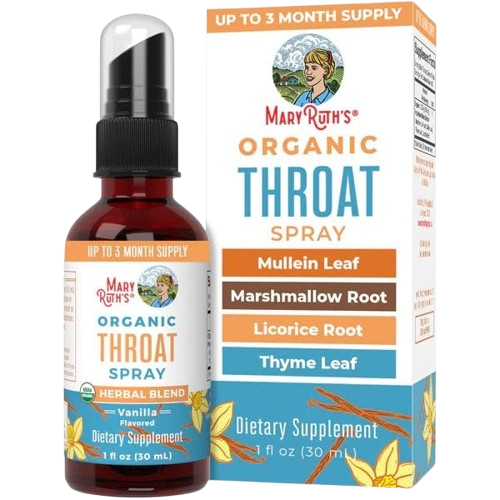
MaryRuth Organics - Throat Spray
An alcohol-free USDA Organic herbal spray combining marshmallow root, mullein, thyme and licorice root.
- Proprietary herbal blend 355 mg (marshmallow root, mullein leaf, thyme leaf, licorice root)
- Alcohol-free
- 1 oz bottle, up to 100 servings
- Four traditional soothing herbs in an organic, alcohol-free formula
- Generous 100 servings per bottle at two sprays per serving
- USDA Organic, Non-GMO, Vegan and manufactured in a GMP facility
- Ingredients listed as a proprietary blend without individual amounts
- Limited buyer reviews (35 ratings) and some are incentivized
- No bee-derived or menthol ingredients, so less multi-action than some competitors
[Why it earned this spot: form, dose versus NHS reference intake, what buyers report.]
MaryRuth Organics offers an alcohol-free herbal spray built around four traditional soothing herbs: marshmallow root, mullein leaf, thyme leaf and licorice root, combined in a 355 mg proprietary blend. Marshmallow root is a well-known demulcent, thyme has a long history of use for respiratory complaints in European herbal traditions, and mullein leaf is traditionally used for throat and lung support. The vegetable glycerin base gives a smooth mouthfeel without the sting of alcohol-based alternatives.
The bottle claims up to 100 servings at two sprays each, which represents strong value if the product works for you. It carries USDA Organic, Non-GMO and Vegan certifications and is manufactured in a GMP facility. The main drawback is transparency: the four herbs are listed as a proprietary blend totaling 355 mg, with no breakdown of individual amounts, so it is impossible to know how much marshmallow root or licorice root you are actually getting per spray. Buyer feedback is also limited, with only 35 ratings on Walmart (4.6/5), and some of those reviews are incentivized. Available in unflavored (herbal blend) and vanilla options.
When to see a doctor about a sore throat
See a doctor or visit urgent care if your sore throat lasts longer than seven days, is accompanied by a fever above 101 °F (38.3 °C), causes difficulty swallowing or breathing, or comes with a rash, joint pain, blood in your saliva or a lump in your neck. Strep throat requires antibiotic treatment and cannot be resolved with natural remedies alone.
Natural remedies are appropriate for mild, viral sore throats – the kind that comes with a common cold and clears up within a week. However, some sore throats have bacterial causes, most notably group A Streptococcus (strep throat), which requires prescription antibiotics to prevent complications such as rheumatic fever. A rapid strep test at your doctor’s office takes only minutes. Children and teenagers with sore throats should be evaluated by a pediatrician or healthcare provider, especially if symptoms include fever, swollen tonsils or difficulty swallowing. Never give honey to a child under one year of age due to the risk of infant botulism.
Common questions about natural sore throat remedies
Does honey really help a sore throat?
There is reasonable evidence that it does. A Cochrane review found that honey may be more effective than usual care, diphenhydramine or no treatment for reducing cough frequency and severity. Honey coats the throat and has mild antibacterial properties. However, it should never be given to children under one year old due to botulism risk.
Is slippery elm safe to take every day?
Slippery elm bark is recognized by the FDA as an oral demulcent and is generally considered safe for short-term use. Because it forms a mucilage coating in the digestive tract, it may slow the absorption of other medications – take it at least two hours apart from any prescription drugs. Long-term safety data is limited, so speak with your healthcare provider if you plan to use it regularly.
Can I use propolis if I have a bee allergy?
No. Propolis is a bee-derived product and can cause severe allergic reactions, including anaphylaxis, in people allergic to bees, bee stings, pollen or bee products. If you have any of these allergies, choose a propolis-free alternative such as a slippery elm tea or a menthol-based lozenge.
What is the fastest natural way to relieve a sore throat?
A throat spray delivers active ingredients directly to the affected area in seconds, making it the fastest-acting format. Warm liquids such as herbal tea with honey also provide quick relief by soothing irritated tissue and thinning mucus. Gargling with warm salt water (half a teaspoon of salt in a glass of warm water) is a simple home remedy recommended by the Mayo Clinic for temporary pain relief.
Are natural sore throat remedies safe during pregnancy?
Some are and some are not. Honey and menthol lozenges are generally considered safe during pregnancy. However, licorice root in large amounts has been associated with adverse pregnancy outcomes in some studies and should be avoided or used only under medical supervision. Herbal ingredients such as slippery elm and marshmallow root lack sufficient safety data in pregnancy. Always consult your midwife or obstetrician before using any herbal product while pregnant or breastfeeding.
The bottom line
For a mild, viral sore throat, a good natural remedy can take the edge off while your body does the real work of fighting the infection. The key is choosing a product with ingredients that have genuine evidence or regulatory recognition behind them, and being honest about what “natural” can and cannot do.
Traditional Medicinals Throat Coat Tea earned our top score for its combination of three proven demulcent and soothing ingredients – slippery elm, licorice root and marshmallow root – all with labeled amounts and strong buyer feedback. If you prefer a portable, on-the-go option, Beekeeper’s Naturals Propolis Throat Spray delivers targeted relief in seconds with a well-regarded propolis formula. And for a soothing lozenge with genuine manuka honey, Wedderspoon’s Organic Manuka Honey Drops offer a tasty, multi-action option.
Whichever product you choose, remember that natural remedies are for symptom relief, not treatment. If your sore throat worsens, persists beyond a week or comes with warning signs such as high fever or difficulty breathing, see a healthcare provider without delay.
Traditional Medicinals - Throat Coat Tea
- FDA-recognized slippery elm demulcent
- Three complementary soothing herbs with labeled amounts
- USDA Organic, Non-GMO, caffeine-free
- 4.7/5 from nearly 700 buyer reviews

Independent guides to natural remedies and supplements, checked against NHS and EFSA references.