Home › Pregnancy & Baby › What are the symptoms of teething in babies?
Pregnancy & BabyWhat are the symptoms of teething in babies?
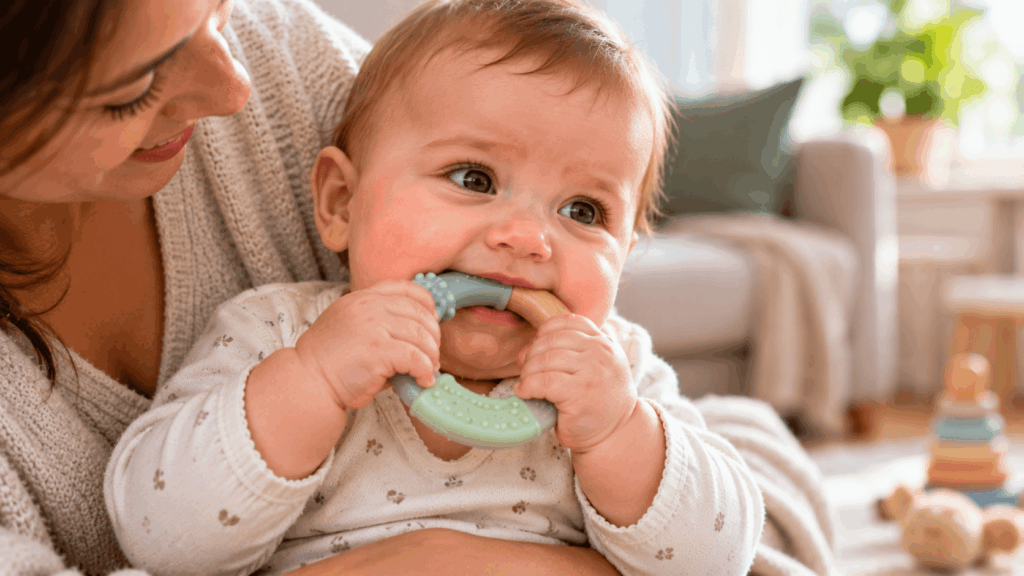
The most common signs of teething are sore, red gums, extra dribbling, chewing on things and general fussiness. Symptoms are usually mild and last only a few days per tooth.
Teething should not cause a high fever (38°C or above), diarrhoea or make your baby seriously unwell. If your baby has these symptoms, do not assume it is teething. Contact your GP or call NHS 111.
Few milestones create quite as much confusion as teething. Every time a baby dribbles, chews a fist or has a difficult night, someone suggests it must be their teeth. Sometimes it is. Often it is not. Babies start producing more saliva at around 2 to 3 months as their salivary glands develop, which can look a lot like teething before any tooth is on the way.
Knowing what teething actually looks like, and what it does not, helps you respond calmly and spot the signs that something else might be going on.
When does teething start?
According to the NHS, most babies get their first tooth at around 6 months. But there is a wide range of normal:
- Some babies begin teething before 4 months
- Others do not get their first tooth until after 12 months
- A few babies are born with teeth (natal teeth), which is uncommon but not usually a concern
Early teething (before 4 months) is not harmful and should not cause problems unless it affects feeding. If your baby seems to be showing teething signs at 10 weeks or 3 months, it is possible, though the increased drooling and chewing at that age is often the salivary glands maturing rather than a tooth on its way.
If you suspect your baby is teething, gently run a clean finger along their gums. You may feel a hard lump or see a white ridge just beneath the surface where a tooth is about to break through. If the gums look smooth and unbothered, the fussiness may have a different cause.
The signs to look for
The NHS lists the following as common teething symptoms. Not every baby will have all of them, and some teeth come through with no visible discomfort at all:
- Sore, red gums where the tooth is pushing through
- A slightly raised temperature (but below 38°C)
- One flushed cheek on the side where the tooth is emerging
- A rash on the face, often around the mouth and chin from extra dribble
- Rubbing their ear on the side of the emerging tooth
- Dribbling more than usual
- Gnawing and chewing on fingers, toys and anything within reach
- Being more fretful or unsettled than normal
- Disturbed sleep
Symptoms tend to be worst in the day or two before a tooth cuts through and usually settle within a few days. Some babies seem barely affected. Others have a harder time, especially when the larger molars come through later.
What teething does not cause
This is one of the most important things to know. The NHS is clear: there is no evidence that teething causes diarrhoea, vomiting, a high fever (38°C or above) or severe illness.
These symptoms are sometimes attributed to teething because babies teethe over many months, and during that same window they are also exposed to infections for the first time. The timing overlaps, but the teeth are not the cause.
If your baby has a temperature of 38°C or above, is vomiting, has diarrhoea, or seems genuinely unwell, do not put it down to teething. Something else is going on and it needs checking.
Your baby has a temperature of 38°C or above (this is not caused by teething and may indicate infection). Your baby seems unusually listless, refuses feeds or is difficult to wake. Symptoms are not improving or are getting worse. You are worried for any reason. You know your baby best. In an emergency, call 999.

What order do baby teeth come in?
The NHS gives the following rough timeline. Every baby is different, and variations of a few months either way are perfectly normal:
- 6 months: central incisors (bottom front teeth, usually first)
- 8 months: lateral incisors (either side of the front teeth)
- 12 months: first molars (back teeth)
- 18 months: canines (pointed teeth between the lateral incisors and molars)
- 24 months: second molars
Bottom teeth often appear before their matching upper teeth. Most children have all 20 milk teeth by the age of 2 to 3.
Early teething: 3 to 4 months
If your baby is showing signs of teething at 3 or 4 months, they may genuinely have a tooth on the way. The NHS confirms that some babies begin teething before 4 months. However, there are other common reasons for the same behaviours at this age:
- Increased drooling is a normal developmental milestone at 2 to 3 months as the salivary glands become active. It does not automatically mean a tooth is coming.
- Chewing on hands and objects is part of how babies explore the world, not just a teething response.
- Fussiness can have many causes at this age, including growth spurts, tiredness and overstimulation.
If you can feel or see a hard ridge in the gum, teething is the likely explanation. If the gums look normal, the behaviours are probably developmental rather than dental.
How to help a teething baby
The NHS recommends simple, low-risk approaches: a chilled teething ring (cooled in the fridge, never frozen), gentle gum rubbing with a clean finger, and sugar-free paracetamol (from 2 months) or ibuprofen (from 3 months) if your baby is in real discomfort. Teething gels have limited evidence of benefit and are a second-line option.
The NHS does not recommend homeopathic teething products. Amber teething necklaces are a choking and strangulation risk and should not be used.
Common questions about teething symptoms
Can a 10-week-old baby be teething?
It is uncommon but possible. The NHS says some babies begin teething before 4 months, and a few are born with teeth. At 10 weeks, however, increased drooling and hand-chewing are more likely to be normal developmental behaviours as the salivary glands become active. If you can see or feel a hard ridge on the gum, speak to your health visitor.
Does teething cause a fever?
Teething may cause a very mild increase in temperature (below 38°C), but it does not cause a proper fever. If your baby’s temperature is 38°C or above, the NHS advises that this is not teething and should be checked by a GP or NHS 111.
How long do teething symptoms last for each tooth?
Each tooth usually takes a few days to break through the gum. The worst discomfort typically happens in the day or two before and as the tooth emerges. Some teeth arrive almost unnoticed, while others (particularly the molars) can be more uncomfortable.
Do teething symptoms come and go?
Yes. Teething happens in waves as different teeth emerge over many months. Your baby may have a difficult few days when a tooth is pushing through, then be perfectly fine until the next one starts. This on-and-off pattern is normal.
Why is teething worse at night?
There is no definitive answer, but some experts suggest that without the distractions of daytime play, babies become more aware of the discomfort. Lying flat may also increase pressure on the gums. A chilled teething ring before bed and a dose of sugar-free paracetamol (if needed) can help settle a teething baby at night.

Independent guides to natural remedies and supplements, checked against NHS and EFSA references.