Home › Natural Remedies › What is pulsatilla used for in homeopathy?
Natural RemediesWhat is pulsatilla used for in homeopathy?
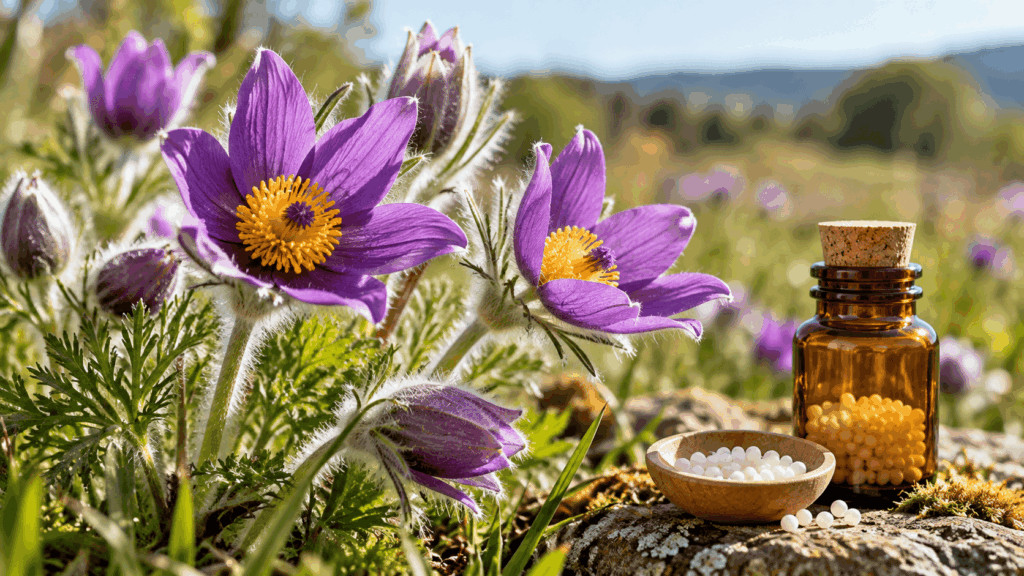
Pulsatilla at a glance
- Pulsatilla is a homeopathic remedy made from the pasque flower (Pulsatilla pratensis), a plant in the buttercup family.
- It is traditionally used for colds with thick, yellow-green discharge, digestive complaints after rich food, and menstrual irregularities.
- There is no good-quality evidence that homeopathic pulsatilla is effective for any health condition. The NHS does not recommend homeopathy as a treatment.
- The fresh plant is toxic and should never be handled or ingested. Only the homeopathic preparation, which is highly diluted, is used.
Pulsatilla is one of the most commonly prescribed remedies in homeopathic practice. It is made from the pasque flower, a low-growing European wildflower, and has been part of the homeopathic tradition for over two hundred years. If you have come across pulsatilla in a pharmacy, a health shop or online, you may be wondering what it is used for, whether it actually does anything, and whether it is safe. This guide covers all of that, with honesty about what the evidence does and does not show.
What is pulsatilla?
Pulsatilla is a homeopathic remedy derived from Pulsatilla pratensis, also known as the pasque flower or wind flower. You may also see it labelled as Pulsatilla nigricans or Pulsatilla vulgaris, which are older botanical synonyms for the same or closely related species. The plant belongs to the Ranunculaceae (buttercup) family and grows wild across parts of northern and central Europe.
In its raw form, the pasque flower is toxic. The fresh plant contains compounds called ranunculin and protoanemonin, which can cause irritation to the skin and mucous membranes and are harmful if swallowed. According to WebMD, pulsatilla in its fresh or dried plant form is considered unsafe to take by mouth, and direct contact with the plant can cause skin irritation.
Homeopathic pulsatilla is a very different product from the raw plant. It is prepared through a process of serial dilution and succussion (vigorous shaking), which is central to homeopathic pharmacy. By the time a remedy reaches the dilutions typically sold (such as 6C or 30C), it contains extremely little, if any, measurable amount of the original plant material. This is one of the reasons homeopathic pulsatilla is generally considered physically safe to take, and also one of the reasons the scientific community questions how it could have a therapeutic effect.
What is pulsatilla traditionally used for?
In homeopathic practice, pulsatilla is considered one of the major “polychrest” remedies, meaning it is used across a wide range of conditions. It is traditionally selected based on a combination of physical symptoms and the person’s overall temperament, which is a distinctive feature of classical homeopathy.
The conditions most commonly associated with pulsatilla in homeopathic tradition include:
- Colds and respiratory complaints. Pulsatilla is traditionally chosen for colds that produce thick, yellow or greenish discharge, particularly when the nose feels blocked indoors but runs freely in the open air. Homeopathic texts describe it as being suited to “ripe” colds where symptoms have moved past the early, watery stage.
- Ear complaints. It is sometimes used in homeopathic practice for ear discomfort associated with colds, particularly in children.
- Digestive complaints. Pulsatilla is traditionally associated with indigestion, bloating or nausea that comes on after eating rich, fatty or heavy food. Homeopathic practitioners describe the typical patient as feeling worse after pastry, cream or pork.
- Menstrual irregularities. In homeopathic tradition, pulsatilla is frequently recommended for periods that are irregular, late or changeable in flow. It is also associated with hormonal transitions such as puberty and the perimenopause.
- Eye complaints. Thick, bland discharge from the eyes, often associated with conjunctivitis or hay fever, is another traditional indication.
A key feature of pulsatilla in homeopathic thinking is changeability. The symptoms it is matched to tend to shift and wander rather than staying fixed. The person who “fits” pulsatilla is traditionally described as mild-mannered, emotional, easily moved to tears, and someone who feels better in fresh air and worse in warm, stuffy rooms.
It is important to understand that these traditional indications come from homeopathic provings (tests conducted within the homeopathic tradition) and historical clinical use, not from conventional clinical trials.
Does it work? What the evidence says
This is where honesty matters. Despite pulsatilla being one of the most widely used homeopathic remedies, there is no good-quality clinical evidence that it is effective for any health condition.
This is not specific to pulsatilla. The NHS does not list homeopathy among the complementary therapies it may offer, noting that the therapies the NHS provides are chosen based on evidence of how well they work. Homeopathy is not included alongside treatments such as acupuncture or hypnotherapy, which have some evidence in specific contexts.
The most comprehensive review of homeopathic evidence to date was conducted by Australia’s National Health and Medical Research Council (NHMRC). Its 2015 evaluation, which assessed the evidence across a wide range of conditions, concluded that there are no health conditions for which there is reliable evidence that homeopathy is effective. No studies specific to pulsatilla were identified that met the quality thresholds for inclusion.
A systematic review of systematic reviews by Ernst (2002), published in the British Journal of Clinical Pharmacology, reached a similar conclusion: the most rigorous studies on homeopathy consistently failed to show effects beyond placebo.
There is also a fundamental scientific objection. At the dilutions commonly used in homeopathic pulsatilla (30C and above), the remedy is diluted far beyond the point at which any molecule of the original plant would be expected to remain. The proposed mechanism, that water retains a “memory” of the substance it once contained, has not been supported by mainstream scientific research.
The current scientific consensus, reflected by the NHS, the NHMRC and multiple systematic reviews, is that homeopathy has not been shown to be effective beyond placebo for any condition. This applies to pulsatilla as much as to any other homeopathic remedy. Some people report finding it helpful, and individual experience is real, but it has not been demonstrated in controlled studies.
Understanding homeopathic potencies
If you look at a homeopathic pulsatilla product, you will see a number and letter on the label, such as 6C, 30C, 200C or 1M. This refers to the potency, which describes how many times the original substance has been diluted.
- C potencies use a 1:100 dilution at each step. A 6C remedy has been diluted 1:100 six times in succession. A 30C remedy has been diluted 1:100 thirty times.
- 1M means one thousand C dilutions (1,000 successive 1:100 dilutions).
At each step, the solution is vigorously shaken (succussed), which homeopathic theory holds is essential for the remedy to work. In conventional chemistry, a 12C dilution is roughly the point at which it becomes unlikely that a single molecule of the original substance remains. A 30C or 1M preparation is diluted far beyond this threshold.
In homeopathic practice, higher potencies are not considered weaker. Homeopaths regard more diluted remedies as more potent, which is the opposite of how dose works in conventional medicine. This is one of the reasons many scientists consider the underlying theory implausible.
Pulsatilla 30C is the potency most commonly available over the counter in UK pharmacies and health shops. Lower potencies such as 6C are sometimes recommended for acute, short-term use, while higher potencies (200C, 1M) are typically prescribed by qualified homeopathic practitioners for longer-standing or constitutional use.

How to use homeopathic pulsatilla
If you choose to use pulsatilla, the following guidance is based on standard homeopathic practice and product labelling. It is not an endorsement of effectiveness.
Homeopathic pulsatilla is most commonly available as small sugar pills (pillules or tablets) that dissolve under the tongue. Some products are also available as liquid drops or granules.
- Standard dosing (acute use, 30C): one tablet or a few pillules dissolved under the tongue, typically taken every two to four hours for short-term symptoms, then reduced as symptoms improve. Most products recommend stopping once you notice a change.
- Lower potencies (6C): may be taken more frequently, such as every one to two hours for the first day, then three times daily.
- Higher potencies (200C, 1M): usually taken as a single dose or a few doses under the guidance of a homeopathic practitioner.
Homeopathic practitioners generally advise taking remedies away from food, drink and strong flavours (especially mint and coffee) by about 15 to 20 minutes, as these are traditionally thought to interfere with the remedy’s action.
Always follow the dosing instructions on the specific product you are using. If symptoms persist, see your GP.
Who should not use pulsatilla
Do not handle or ingest the fresh pasque flower plant. It contains protoanemonin, which is toxic and can cause severe irritation to the skin, mouth, throat and digestive tract. Only the homeopathic preparation, which is highly diluted, is used as a remedy.
If you are pregnant or breastfeeding, speak to your GP, midwife or pharmacist before taking any homeopathic remedy, including pulsatilla. WebMD notes that pulsatilla should be avoided during pregnancy.
If you have a known allergy to plants in the buttercup family (Ranunculaceae), exercise caution and consult a pharmacist before use.
If you are taking prescribed medication for a health condition, do not stop or change your treatment in favour of a homeopathic remedy. The NHS advises that you should never stop taking prescribed medicine without first speaking to your doctor.
Keep all homeopathic remedies out of the reach of children.
While homeopathic preparations at standard dilutions (6C and above) are generally considered physically safe because they contain little or no measurable active substance, the main safety concern with any homeopathic remedy is the risk of delaying conventional treatment for a condition that needs medical attention.
If you are using pulsatilla for symptoms that persist for more than a few days, or that are getting worse, see your GP. This is particularly important for children, for persistent ear or eye complaints, and for any menstrual irregularity that is new or unexplained.
Common questions about pulsatilla
What is pulsatilla 30C used for in homeopathy?
Pulsatilla 30C is the most commonly available potency in the UK. In homeopathic practice, it is traditionally selected for colds with thick, yellow-green nasal discharge, digestive complaints after rich or fatty food, and irregular periods. The “30C” means the original plant extract has been diluted 1:100 thirty times. There is no good-quality clinical evidence that pulsatilla 30C is effective for any health condition.
Is pulsatilla safe to take?
Homeopathic pulsatilla at standard dilutions (6C and above) is generally considered physically safe because it contains extremely little, if any, measurable plant material. However, the fresh pasque flower plant is toxic and should never be ingested. If you are pregnant, breastfeeding, or taking prescribed medication, speak to your GP or pharmacist before using pulsatilla.
What is the difference between Pulsatilla pratensis and Pulsatilla nigricans?
They are essentially the same plant. Pulsatilla nigricans is an older botanical name (synonym) for Pulsatilla pratensis, the common pasque flower used in homeopathic preparations. You may see either name on product labels, but they refer to the same species and the same remedy.
What does pulsatilla 1M mean?
In homeopathic notation, 1M means one thousand C dilutions, each at a ratio of 1:100. This is an extremely high dilution, far beyond the point at which any molecule of the original plant would be expected to remain. Pulsatilla 1M is typically prescribed by qualified homeopathic practitioners rather than used for self-care, and is usually given as a single dose.
Can I take pulsatilla during pregnancy?
It is best to speak to your GP or midwife before taking any homeopathic remedy during pregnancy. WebMD advises that pulsatilla should be avoided in pregnancy. If you are experiencing symptoms during pregnancy, your GP or midwife can advise on safe and evidence-based options.

Independent guides to natural remedies and supplements, checked against NHS and EFSA references.