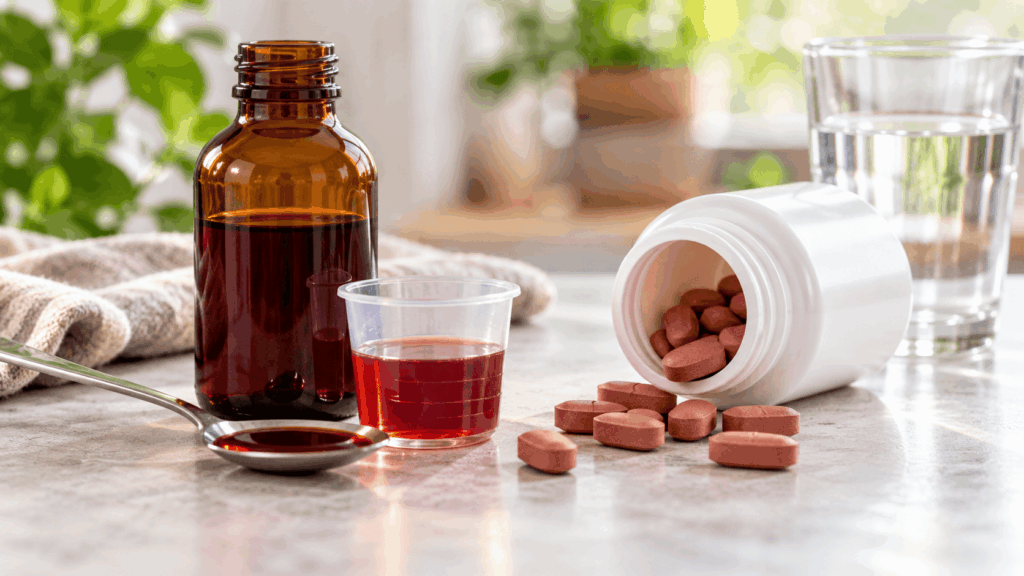
Neither is universally better. Research shows that iron from a tablet is absorbed just as well as iron from a liquid supplement.
The main differences are practical. Tablets usually deliver more elemental iron per dose and are what GPs prescribe first. Liquid iron is easier to swallow, allows more flexible dosing, and may suit people who struggle with tablets. It can, however, stain teeth and often costs more for the same amount of iron.
If you have been told your iron is low, one of the first decisions is what form of supplement to take. Liquid iron products are widely marketed as gentler and easier to absorb, while tablets remain the standard first-line treatment prescribed by GPs across the UK. So which one should you choose?
The honest answer is that it depends on you, not on the format. Here is what the evidence actually says.
Does the body absorb liquid iron better than tablets?
No. Research shows that iron from a tablet is absorbed just as well as iron from a liquid supplement, provided both contain the same type and dose of iron. A UK-based comparison study of oral iron preparations found that among solid forms, conventional-release ferrous sulfate tablets had the highest iron absorption, while modified-release tablets and capsules performed significantly worse.
The form of iron (ferrous sulfate, ferrous fumarate, ferrous gluconate, iron polymaltose) and the dose of elemental iron matter more than whether it comes as a tablet or a liquid. Two products containing the same amount of elemental iron and the same type of iron salt will be absorbed similarly, regardless of format.
Iron supplements list the weight of the iron compound (e.g. ferrous sulfate 200 mg), but not all of that is absorbable iron. The amount your body can actually use is called elemental iron. Ferrous sulfate 200 mg contains roughly 65 mg of elemental iron. Ferrous fumarate 210 mg contains roughly 69 mg. Many over-the-counter liquid iron products contain far less elemental iron per dose, sometimes as little as 5 to 14 mg, which means they are not comparable to a prescribed tablet on a dose-for-dose basis.
What GPs in the UK usually prescribe
The BNF (British National Formulary) and NHS clinical guidance recommend starting treatment with an oral iron supplement providing 50 to 100 mg of elemental iron a day. The most common first-line options are:
- Ferrous sulfate 200 mg tablets (about 65 mg elemental iron), once a day
- Ferrous fumarate 210 mg tablets (about 69 mg elemental iron), once a day
Updated BNF guidance now recommends once-daily or alternate-day dosing rather than two or three times daily. Research has shown that taking iron every other day results in nearly twice the absorption rate per dose compared to daily dosing, with fewer side effects.
If tablets are not tolerated or cannot be swallowed, GPs may prescribe a liquid alternative such as sodium feredate (Sytron). This delivers a similar dose of elemental iron in liquid form and is also available for children.
When liquid iron might be the better choice
Liquid iron has some genuine practical advantages for certain people:
- Difficulty swallowing tablets. This is common in older adults, children, pregnant women with nausea, and anyone with swallowing difficulties.
- Flexible dosing. A liquid lets you adjust the dose more precisely, which is useful for children or when your GP recommends a lower starting dose to minimise side effects.
- Stomach sensitivity. Some people find they can tolerate a smaller, more frequent dose of liquid iron better than a single tablet, although this varies from person to person.
- Children. Paediatric iron supplements in the UK are usually liquid formulations. The dose is calculated by weight and adjusted as the child grows.
When tablets are the simpler option
- Higher elemental iron per dose. A single ferrous sulfate 200 mg tablet delivers roughly 65 mg of elemental iron. Many over-the-counter liquid supplements deliver considerably less per dose, meaning you may need to take more product (and spend more) to get the same amount.
- Convenience. One tablet a day is straightforward. No measuring, no refrigeration, no concerns about taste.
- No teeth staining. Liquid iron can temporarily discolour teeth if it comes into contact with them. Using a straw and rinsing your mouth with water after each dose helps, but it is an extra step.
- Cost. Prescribed ferrous sulfate tablets are very inexpensive. Over-the-counter liquid iron products (such as tonic-style supplements) tend to cost more for the amount of elemental iron they provide.
Take iron with a source of vitamin C (a glass of orange juice, a handful of strawberries) to boost absorption. Avoid tea, coffee and calcium-rich foods for at least an hour either side. The best time to take iron is in the morning, when hepcidin levels are lowest and absorption is highest. If it upsets your stomach, try taking it every other day rather than stopping altogether.

What about over-the-counter liquid iron products?
Products like iron tonics and herbal liquid supplements are popular in the UK. They are widely available in health food shops and pharmacies. Some contain iron in forms such as iron gluconate, iron bisglycinate or iron-rich plant extracts.
These products can be a convenient option if your iron stores are mildly low and your GP is happy for you to try an over-the-counter supplement. However, there are a few things to be aware of:
- The elemental iron content is often much lower than a prescribed tablet (sometimes 5 to 14 mg per dose vs 65 mg in a standard ferrous sulfate tablet). Check the label carefully.
- They are not usually strong enough to treat diagnosed iron deficiency anaemia on their own. If your GP has diagnosed anaemia, they will normally prescribe a higher-dose product.
- Some contain added B vitamins, vitamin C or herbal extracts. The vitamin C may genuinely help absorption. The herbal ingredients are unlikely to make a meaningful difference to iron levels.
A note on modified-release iron tablets
Some iron supplements are sold as modified-release (slow-release) tablets or capsules. These are designed to release iron gradually, which can reduce stomach discomfort. However, research suggests that modified-release iron is absorbed less effectively than conventional-release tablets, because the iron is released further along the gut where absorption is poorer. The BNF does not recommend modified-release iron preparations as a first choice.
When to see your GP
You think you may be iron deficient (do not start a high-dose supplement without a blood test first). Your iron levels have not improved after 4 to 6 weeks of taking a supplement. You are experiencing side effects you cannot manage (persistent nausea, constipation, stomach pain, black stools). You are pregnant or breastfeeding and unsure which supplement is right for you. You are considering an iron supplement for a child. Always keep iron supplements out of the reach of children. Iron is toxic in overdose, and small children are particularly at risk.
Common questions about liquid iron vs tablets
Is liquid iron gentler on the stomach than tablets?
Not necessarily. The side effects of iron (nausea, constipation, stomach cramps) are caused by the iron itself, not by whether it comes as a liquid or a tablet. Some people do find liquid easier to tolerate because they can start with a lower dose and build up gradually, but the same approach can work with half a tablet or alternate-day dosing. If stomach problems persist, speak to your GP about switching to a different form of iron.
Can I take liquid iron instead of tablets my GP prescribed?
Speak to your GP before making a switch. Prescribed tablets usually contain a specific dose of elemental iron chosen for your level of deficiency. Many over-the-counter liquid products contain significantly less iron per dose, which may not be enough to correct your deficiency in the same timeframe. Your GP can prescribe a liquid alternative (such as sodium feredate) if tablets are not suitable.
Does liquid iron stain your teeth?
It can. Liquid iron can leave a temporary grey or black stain on teeth if it sits on the enamel. You can reduce this by drinking it through a straw, rinsing your mouth with water straight afterwards, and brushing your teeth as normal. The staining is not permanent and fades once you stop taking the supplement.
How long does it take for iron supplements to work?
Most people start to feel less tired within a few weeks of starting the right dose. The NHS recommends rechecking your blood levels after about 4 weeks. It usually takes 2 to 3 months of supplementation to bring haemoglobin back to a normal range, and your GP may advise continuing for a further 3 months to rebuild your iron stores (ferritin).
Should I take iron every day or every other day?
Updated BNF guidance supports once-daily or alternate-day dosing. Research shows that alternate-day dosing can lead to better absorption per dose and fewer side effects. Your GP will advise based on how low your levels are and how well you tolerate the supplement.

Independent guides to natural remedies and supplements, checked against NHS and EFSA references.