Home › Natural Remedies › Are herbal remedies safe, and do they work?
Natural RemediesAre herbal remedies safe, and do they work?
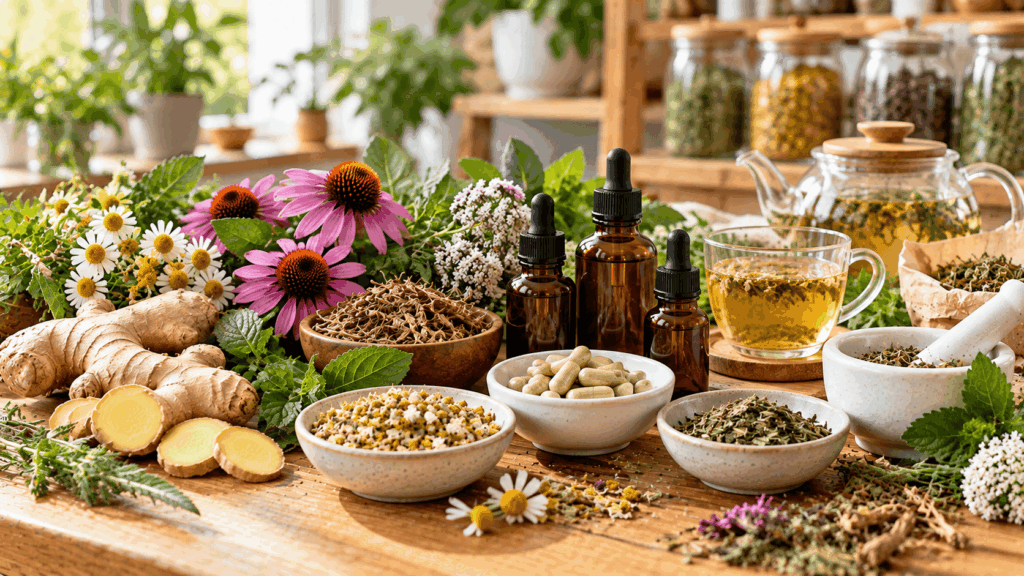
It depends on the herb. A small number have reasonable evidence behind them, but many do not, and 'natural' does not mean safe.
Some herbal remedies, such as ginger for nausea, have good-quality evidence of benefit. Many others have limited or no reliable evidence. All herbal remedies can cause side effects or interact with medicines. The NHS advises checking for the THR certification mark and speaking to a pharmacist or GP before taking any herbal product, especially if you take prescribed medication.
Herbal remedies are among the most popular forms of self-care in the UK, and they sit in an unusual space: widely available in pharmacies and health shops, yet not tested or regulated in the same way as conventional medicines. The question of whether they are safe and whether they work does not have a single answer, because it depends entirely on which herb, at what dose, for what purpose and in what context. This guide looks at what the evidence actually says, how herbal products are regulated in the UK and what you should check before taking one.
Why so many people are asking
Interest in herbal remedies has grown steadily in the UK and worldwide. Many people turn to them because they prefer a “natural” approach, because conventional treatment has not helped, or because they want to manage mild symptoms without seeing a doctor. A BMJ editorial by Professor Edzard Ernst noted that herbal medicine use was already rising sharply in the early 2000s, and the trend has continued since.
The difficulty is that “natural” is not a regulated term and does not guarantee safety or effectiveness. The Mayo Clinic points out that many “natural” products are highly processed, and plant-based substances can have powerful effects on the body. Foxglove, for example, is a plant that yields digoxin, a drug used in heart medicine, but eating the plant itself can be deadly.
Which herbal remedies have evidence behind them?
The evidence base varies enormously from one herb to another. A handful have been studied in well-designed clinical trials. Many others have only traditional use, laboratory studies or small, poorly designed trials to support them.
Herbs with the strongest evidence:
- Ginger for nausea. Ginger has good evidence for relieving nausea, including pregnancy-related and post-operative nausea. The University of Rochester Medical Center notes that it has been studied for surgery-related nausea and as a supportive treatment in cancer care.
- St John’s wort for mild to moderate depression. A meta-analysis of 23 randomised controlled trials (1,757 patients) found it more effective than placebo and comparable to conventional antidepressants for mild to moderate depression. However, it has serious drug interactions (see below) and the Cleveland Clinic advises caution because of these and because product quality varies widely.
- Horse chestnut seed extract for chronic venous insufficiency. A review of 13 RCTs (1,083 patients) found positive results in placebo-controlled trials and equivalence with other active treatments for symptoms of poor leg vein circulation.
Herbs with mixed or limited evidence:
- Echinacea for colds. Evidence is mixed. Some studies suggest a small reduction in cold duration, but results are inconsistent and the effect, if real, is modest.
- Ginkgo biloba for memory and dementia. Early reviews were promising, but more recent and larger studies have produced inconsistent results. The Cleveland Clinic describes the evidence as inconclusive.
- Saw palmetto for enlarged prostate symptoms. Earlier meta-analyses were positive, but more recent, well-designed trials found no benefit over placebo for urinary symptoms associated with benign prostatic hyperplasia.
- Valerian for sleep. Widely used as a sleep aid, but the evidence from controlled trials is mixed and does not reliably demonstrate a benefit beyond placebo.
The evidence for herbal remedies changes as new studies are published. Saw palmetto was once considered effective for prostate symptoms, but larger and more rigorous trials later failed to confirm the earlier findings. This is a normal part of how science works, but it means that claims based on older studies may no longer hold up.
Why “natural” does not mean safe
One of the most important things to understand about herbal remedies is that they contain pharmacologically active compounds. That is what makes some of them potentially useful, but it is also what makes them capable of causing harm. The NHS states clearly that not all herbal medicines are safe or suitable for everyone.
Safety concerns fall into several categories:
- Direct side effects. Some herbs can cause significant problems on their own. Ephedra, for example, was linked to heart attacks, strokes and deaths before being banned from supplements in the United States in 2004. Kava has been associated with serious liver damage. Liquorice root can raise blood pressure and lower potassium levels.
- Drug interactions. This is one of the most serious risks. The NHS specifically warns that herbal medicines may interact with statins, antidepressants, diabetes medicines such as metformin, blood pressure medicines such as ramipril, blood thinners such as warfarin and hormonal contraception including the combined pill. St John’s wort is one of the worst offenders: it can reduce the effectiveness of the contraceptive pill, HIV drugs, immunosuppressants and many other medicines.
- Quality and contamination. Professor Ernst’s BMJ editorial highlighted cases of undeclared steroids found in herbal creams sold in the UK and severe kidney damage linked to Chinese herbal teas. Because many herbal products are sold as food supplements rather than medicines, quality control can be inconsistent.
- Misleading labels. Products may not contain what the label states, may contain less (or more) of the active herb than claimed, or may include fillers, pesticides or heavy metals.
How herbal remedies are regulated in the UK
The UK has a specific regulatory framework for herbal medicines that is worth understanding, because it directly affects product quality and safety.
The Traditional Herbal Registration (THR) scheme, overseen by the Medicines and Healthcare products Regulatory Agency (MHRA), is the main route for herbal products to be legally marketed as medicines in the UK. To be granted a THR, a product must meet standards for quality, safety and evidence of at least 30 years of traditional use. The THR scheme covers only minor health conditions where medical supervision is not required, such as colds, coughs or mild sleep difficulties.
The NHS advises looking for the THR certification mark on the packaging. This tells you the product has been assessed by the MHRA and meets the required standards. It does not mean the product has been proven to work in clinical trials, but it does mean the quality, safety and manufacturing standards have been checked.
Many herbal products sold in the UK, however, are marketed as food supplements rather than medicines. These are regulated under food law, which has lower requirements for evidence and quality control. They cannot make medicinal claims, but in practice the distinction is not always obvious to consumers.
Look for the THR certification mark and an MHRA product licence number on the packaging. If a herbal product does not carry these, it has not been assessed under the THR scheme. The NHS advises against buying unlicensed herbal medicines online, as they may not be safe or contain what the label claims.
Who should be especially careful
Check with your GP or pharmacist first if youAre taking any prescribed medication, particularly blood thinners (warfarin), statins, antidepressants, diabetes medicines, blood pressure medicines or hormonal contraception.

Are pregnant or breastfeeding. The NHS states that herbal medicines are not recommended in pregnancy.

Have a liver or kidney condition. Some herbs can worsen these.

Are due to have surgery. Several herbs, including ginkgo, garlic and ginseng, can increase bleeding risk. Tell your surgical team about everything you take.

Have an allergy to plants in the daisy family (Asteraceae), as you may react to echinacea, chamomile or feverfew.

Are considering giving a herbal product to a child. The NHS states that herbal medicines are not recommended for children because safety in this group is not well understood.
The American Geriatrics Society adds that older adults are at particular risk because they are more likely to take multiple medicines, making interactions harder to predict. Anyone taking warfarin should be especially cautious, as it is the medicine most likely to interact with herbal products.

How to use herbal remedies more safely
If you choose to use a herbal remedy, the following steps can reduce your risk:
- Buy products with the THR mark. This is the single most reliable indicator of quality and safety for herbal medicines in the UK.
- Tell your GP and pharmacist. Always mention any herbal products you take, even if you think they are mild. Your pharmacist can check for interactions with your other medicines.
- Do not assume that “traditional” means effective. A long history of use is not the same as clinical proof. Traditional use may indicate that a remedy is relatively safe at normal doses, but it does not confirm that it works for the condition it is sold for.
- Follow the recommended dose. More is not better. Some herbs, including liquorice root and ginkgo, can cause serious problems at high doses.
- Do not replace prescribed treatment. The NHS is clear that herbal medicines should not be used instead of medicines prescribed by your doctor, and you should never stop a prescribed medicine in order to take a herbal one.
- Report side effects. You can report suspected side effects from herbal medicines through the MHRA Yellow Card scheme, just as you would for conventional medicines.
When to speak to your GP
If you are using herbal remedies and your symptoms are not improving, getting worse or lasting longer than expected, see your GP. Herbal products are intended for self-care of minor, short-term complaints. Persistent or unexplained symptoms, including ongoing fatigue, pain, digestive problems or changes in mood, need proper medical assessment to rule out an underlying condition.
You should also see your GP if you experience any unexpected side effects after starting a herbal product, including skin reactions, digestive upset, headaches, dizziness or changes in how your other medicines seem to be working.
Common questions
Are herbal remedies regulated in the UK?
Some are. Herbal medicines registered under the MHRA’s Traditional Herbal Registration (THR) scheme have been assessed for quality, safety and evidence of traditional use. Look for the THR mark on the packaging. However, many herbal products are sold as food supplements, which are subject to less stringent regulation.
Can herbal remedies interact with prescription medicines?
Yes, and some interactions can be serious. St John’s wort, for example, can reduce the effectiveness of the contraceptive pill, HIV drugs and immunosuppressants. The NHS warns that herbal medicines may interact with statins, antidepressants, diabetes medicines, blood thinners and blood pressure medicines. Always check with your pharmacist before combining a herbal product with any prescribed medication.
Is it safe to take herbal remedies during pregnancy?
The NHS states that herbal medicines are not recommended during pregnancy or breastfeeding because their safety in these groups is not well enough understood. If you are pregnant and considering a herbal product, speak to your GP or midwife first.
What does the THR mark mean on a herbal product?
The Traditional Herbal Registration (THR) mark shows that the product has been assessed by the MHRA for quality, safety and evidence of at least 30 years of traditional use. It does not mean the product has been proven effective in clinical trials, but it does mean it has met regulatory standards for safety and manufacturing quality.
Are herbal teas safe?
Most common herbal teas, such as chamomile and peppermint, are considered safe for most adults when consumed in normal amounts. However, some herbal teas can interact with medicines or cause allergic reactions, and the NHS advises caution during pregnancy. If you drink herbal teas regularly and take prescribed medication, mention this to your pharmacist.

Independent guides to natural remedies and supplements, checked against NHS and EFSA references.