Home › Best Supplements › What is the best magnesium for leg cramps and sleep?
RankingsWhat is the best magnesium for leg cramps and sleep?
We may earn a commission when you buy through links on this page. No brand pays to be ranked. How we rank products

If you have ever been woken at 3 a.m. by a charley horse seizing your calf, you know the desperation that follows: what can I take to stop this happening again? Magnesium is the supplement most people reach for, and it is also one of the most searched-for natural sleep aids. The logic seems solid. Magnesium plays a role in muscle contraction, nerve signaling and the regulation of melatonin, so topping up a low level should help with both cramps and sleep.
The reality is more nuanced than the marketing suggests. The evidence for magnesium and leg cramps is surprisingly weak, while the evidence for sleep is limited but somewhat more encouraging. What is not in dispute is that nearly half of Americans fall short of the recommended daily intake, and that correcting a genuine shortfall can have broad benefits for muscle, nerve and metabolic health.
We scored five widely available magnesium supplements in the US on dose, tolerance, value and buyer feedback. Every product claim was verified against its label or official listing, and every buyer quote comes from a named review platform.
Doctor's Best High Absorption Magnesium is our highest-scoring magnesium supplement, combining chelated Albion TRAACS glycinate with the best value per serving in our ranking.
Our top pick is Doctor's Best – High Absorption Magnesium, a chelated glycinate/lysinate form with over 217,000 reviews on Amazon. For a budget-friendly Albion bisglycinate, NOW Foods – Magnesium Glycinate offers strong certification coverage at a fair price. If you prefer a drink to a tablet, Natural Vitality – Calm is the most popular magnesium powder on the US market.
What the evidence actually says about magnesium, cramps and sleep
Magnesium is involved in over 300 enzymatic reactions in the body, including muscle contraction, nerve transmission and energy metabolism. The National Institutes of Health estimates that 48% of Americans consume less than the Estimated Average Requirement from food alone, which is one reason magnesium supplements are so popular. But being common does not make a deficiency the cause of every cramp or restless night.
For leg cramps, the most rigorous evidence comes from a 2020 Cochrane review by Garrison and colleagues. It pooled 11 randomised controlled trials with 735 participants and concluded that magnesium is “unlikely to provide a clinically meaningful reduction in the frequency of cramps” for the general population. The evidence for pregnant women was conflicting, with some trials showing a small benefit and others showing none. This does not mean magnesium is useless for cramps, but it does mean the effect, if it exists, is small and inconsistent. If cramps are caused by a genuine magnesium shortfall, correcting that shortfall may help, but routine supplementation in people with adequate levels is unlikely to make a difference.
For sleep, the picture is slightly more encouraging. A 2012 trial in older adults by Abbasi and colleagues found that 500 mg of magnesium daily for eight weeks improved subjective sleep quality, sleep time and sleep onset compared to placebo. A 2021 meta-analysis by Mah and Pitre reported a possible reduction in sleep onset latency of about 17 minutes, though the authors noted the evidence quality was too low to draw firm conclusions. Magnesium may support sleep partly through its role in regulating GABA, the neurotransmitter that calms the nervous system, and partly through its influence on melatonin production. The glycine in magnesium glycinate may add a mild calming effect of its own, as glycine is itself a recognized inhibitory neurotransmitter.
Not all leg cramps are caused by low magnesium. Common triggers include dehydration, prolonged sitting or standing, overexertion, certain medications (statins, diuretics) and nerve compression. A blood test for serum magnesium can flag a severe deficiency, but it is a poor marker of total body stores because less than 1% of magnesium sits in the blood. If cramps persist despite supplementation, the cause may lie elsewhere.
What to look for in a magnesium supplement
Form matters more than dose
Magnesium supplements come in many forms, and the form determines how well the mineral is absorbed and how it affects your gut. Glycinate (also called bisglycinate) is magnesium bound to the amino acid glycine. It is among the best-absorbed forms and is the gentlest on the stomach, making it the default choice for daily supplementation and evening use. Citrate is well absorbed and widely studied for cramps, but it has a mild laxative effect at higher doses, which is a drawback for some users and a feature for others. Oxide is cheap and delivers a high milligram count on the label, but its actual absorption rate is poor, and it is the most likely form to cause digestive upset.
Dose against the RDA
The Recommended Dietary Allowance for magnesium in the US is 400 to 420 mg per day for adult men and 310 to 320 mg for adult women, from all sources combined. The average American diet provides roughly 250 to 270 mg, so a supplement in the range of 100 to 350 mg typically bridges the gap. The NIH sets the Tolerable Upper Intake Level for magnesium from supplements and fortified foods at 350 mg per day. Going above this level is not necessarily dangerous, but it increases the risk of diarrhea and cramping, particularly with citrate and oxide forms.
Third-party testing
Unlike prescription drugs, dietary supplements in the US are not required to prove purity or potency before reaching store shelves. Third-party certifications such as NSF International, USP, Informed Choice and Non-GMO Project Verified provide an independent check that what is on the label matches what is in the bottle. For athletes subject to anti-doping testing, NSF Certified for Sport is the gold standard.
If you are taking magnesium primarily for sleep, take it 30 to 60 minutes before bed. Glycinate is the preferred form for this purpose because the glycine component may add a mild calming effect on top of the magnesium itself. Start at a moderate dose and increase gradually to assess your personal tolerance.
How we scored these supplements
We evaluated each product on four criteria, weighted to reflect what matters most when choosing a magnesium supplement for cramps and sleep. Every ingredient was verified against the product label or official listing, and every buyer quote comes from a named review platform.
- Dose vs RDA (35%) – How much elemental magnesium does a single serving deliver relative to the adult RDA, and is the form well absorbed? Higher weight because dose and bioavailability are the primary determinants of whether the supplement actually raises your magnesium level.
- Tolerance (25%) – How gentle is the formula on the stomach? Does the form have a known laxative effect? Are the excipients minimal and clean?
- Value (20%) – How many servings does the container provide, and what is the approximate cost per serving? A low per-serving cost matters because magnesium is taken daily and indefinitely.
- Buyer feedback (20%) – What do verified buyers say on Amazon, Sam’s Club, iHerb and other platforms, weighted toward comments about cramps and sleep specifically?
Scores run from 0 to 10, rounded to one decimal place, and decrease strictly from our top pick to our fifth. Full methodology: how we rank products.

Our ranking at a glance
| Rank | Product | Form & dose | Score | |
|---|---|---|---|---|
| #1Best overall | Doctor's Best - High Absorption Magnesium | Chelated glycinate/lysinate (Albion TRAACS) 200 mg per serving (2 tablets) | 9.2/10 | Check price |
| #2Best value | NOW Foods - Magnesium Glycinate | Bisglycinate (Albion) 200 mg per serving (2 tablets) | 8.3/10 | Check price |
| #3Best powder | Natural Vitality - Calm | Ionic magnesium citrate 350 mg per serving (2 tsp) | 8.2/10 | Check price |
| #4Best for sport | Transparent Labs - MAG Bisglycinate | Bisglycinate chelate 300 mg per serving (3 capsules) | 7.9/10 | Check price |
| #5Best premium | Thorne - Magnesium Bisglycinate | Magnesium glycinate 120 mg per capsule | 7.6/10 | Check price |
Our picks, reviewed
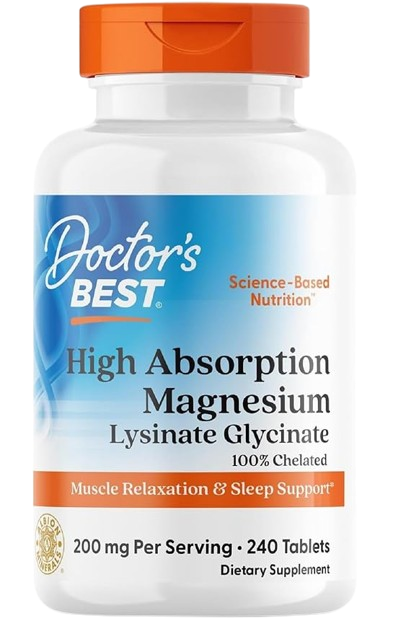
Doctor's Best - High Absorption Magnesium
A chelated glycinate/lysinate form using patented Albion TRAACS technology, with over 217,000 reviews on Amazon and the best cost per serving in our ranking.
- Formchelated magnesium glycinate/lysinate (Albion TRAACS)
- Elemental magnesium200 mg per serving (2 tablets)
- Container240 tablets (120 servings)
- Certificationsnon-GMO, vegan, gluten-free, soy-free
- you want the best-reviewed magnesium glycinate at the lowest cost per serving
- you want a chelated form for better absorption without stomach issues
- you prefer a single-capsule serving rather than two tablets
- you want a powder you can mix into a drink
Doctor's Best uses Albion TRAACS chelated magnesium, a patented process that bonds magnesium to the amino acids glycine and lysine. Chelation is designed to protect the mineral through the digestive tract and improve absorption compared to non-chelated forms such as oxide. Each two-tablet serving delivers 200 mg of elemental magnesium, roughly 48 to 63% of the adult RDA depending on age and sex. The formula is vegan, non-GMO, gluten-free and soy-free.
What sets this product apart is its sheer volume of positive feedback. On Amazon, it holds 4.8 out of 5 stars across more than 217,000 ratings. One buyer wrote "Been using for muscle cramps. Already feeling results" (quintinbullock, eBay). Another reported "When I take it, no pain" (mary4471son, eBay), describing how cramps and poor sleep returned whenever the supplement was stopped. At 120 servings per container, the cost per serving is the lowest in our ranking.
Where to buy
Prices change often, so we don't show them here: check the retailer for today's price.
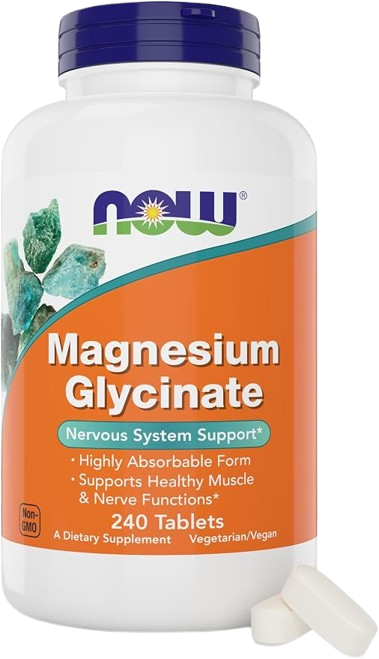
NOW Foods - Magnesium Glycinate
An Albion bisglycinate formula from one of the most established supplement brands in the US, with vegan, kosher, halal and GMP certifications.
- Formmagnesium bisglycinate (Albion)
- Elemental magnesium200 mg per serving (2 tablets)
- Container180 tablets (90 servings)
- Certificationsnon-GMO, vegan, kosher, halal, GMP
- you want a reputable Albion bisglycinate with broad certification coverage
- you prefer a supplement with kosher and halal certification
- you want a higher dose per serving without doubling up
- you prefer a capsule rather than a tablet
NOW Foods has been manufacturing supplements since 1968 and is one of the most widely distributed brands in the US natural products market. This formula uses Albion bisglycinate, the same chelation technology as our top pick, delivering 200 mg of elemental magnesium per two-tablet serving. The certification list is notably broad: non-GMO, vegan, kosher, halal and manufactured in a GMP-certified facility.
Buyer feedback across retail platforms is consistently positive, with many reviewers noting improved sleep quality within two to four weeks and good digestive tolerance compared to cheaper magnesium oxide products. Some users report mild stomach discomfort when taking the tablets on an empty stomach, so taking them with food is worth trying if this affects you. The 90-serving container is slightly less economical per serving than Doctor's Best, which accounts for the lower value score, but the broader certification coverage may matter more to some buyers.
Where to buy
Prices change often, so we don't show them here: check the retailer for today's price.
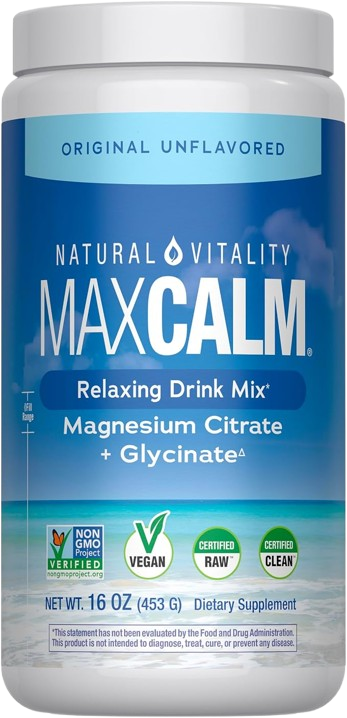
Natural Vitality - Calm
The best-selling magnesium powder in the US, using ionic magnesium citrate in a fizzy drink mix with flexible dosing from half a teaspoon up.
- Formionic magnesium citrate powder
- Elemental magnesium350 mg per serving (2 tsp)
- Container8 oz (~57 servings)
- Certificationsvegan, Non-GMO Project Verified
- you dislike swallowing capsules or tablets and prefer a warm drink
- you want the flexibility to adjust your dose from a quarter teaspoon up
- you want a bisglycinate form rather than citrate
- citrate tends to loosen your stools
Natural Vitality Calm is the best-selling magnesium powder in the US and the only non-capsule product in our ranking. You mix one to two teaspoons into hot or warm water, where it fizzes and dissolves into a drinkable supplement. The active form is ionic magnesium citrate, which is well absorbed but has a known mild laxative effect at higher doses. The full two-teaspoon serving delivers 350 mg of elemental magnesium, just at the NIH upper limit for supplements, but the powder format lets you easily start at half a teaspoon and work up.
The product is vegan and Non-GMO Project Verified. On Sam's Club, one buyer wrote "it helps me relax and sleep also" (K.P., Sam's Club). Another reported that it "STOPS Restless Leg Syndrome and muscle cramps" (G., Sam's Club). The tolerance score is the lowest in our ranking because citrate is more likely to cause loose stools than glycinate or bisglycinate, particularly at the full 350 mg serving. If your digestion is sensitive, start low and see how you respond.
Where to buy
Prices change often, so we don't show them here: check the retailer for today's price.
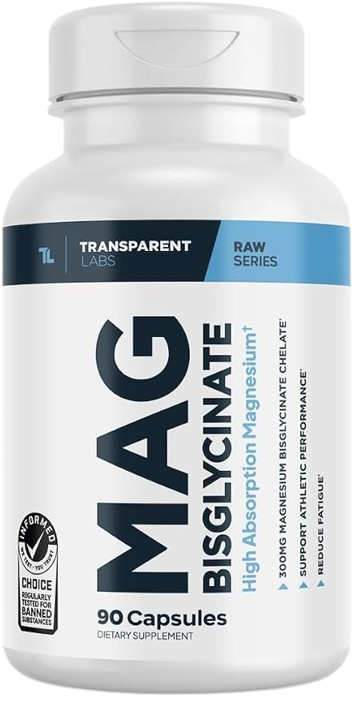
Transparent Labs - MAG Bisglycinate
A 300 mg bisglycinate chelate in a third-party tested formula from a sport-focused supplement brand, designed for recovery and sleep.
- Formmagnesium bisglycinate chelate
- Elemental magnesium300 mg per serving (3 capsules)
- Container90 capsules (30 servings)
- Third-party tested, non-GMO, gluten-free
- you want a higher 300 mg dose in a third-party tested formula
- you train regularly and want a sport-focused supplement brand
- 30 servings per container runs out quickly at daily use
- you prefer a lower, more flexible dose
Transparent Labs positions itself as a sport-nutrition brand with full ingredient transparency, and this magnesium product follows that approach. Each three-capsule serving delivers 300 mg of elemental magnesium from bisglycinate chelate, the highest per-serving dose in our ranking. The formula is third-party tested, non-GMO, gluten-free and free from artificial flavors, sweeteners and colorings.
The 300 mg dose is well suited to active individuals who lose magnesium through sweat and have higher turnover demands. On the brand's website, one buyer wrote "My eyes get heavy, and I sleep like a baby" (Kari K., transparentlabs.com). The main trade-off is the 30-serving container, which means you will go through a bottle in a month at daily use, pushing the effective cost per serving above the glycinate tablets in our top two spots. The three-capsule serving size may also be a drawback if you prefer fewer pills.
Where to buy
Prices change often, so we don't show them here: check the retailer for today's price.
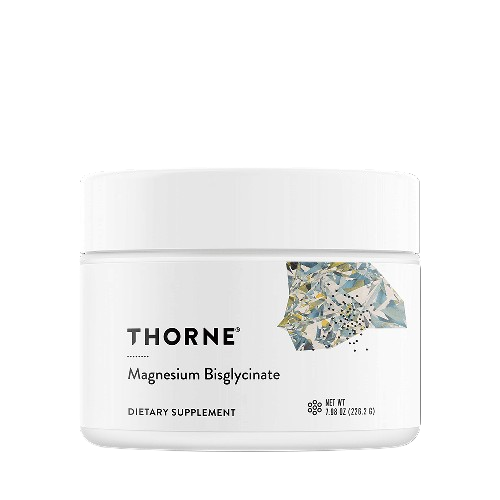
Thorne - Magnesium Bisglycinate
A practitioner-grade magnesium glycinate with minimal excipients and flexible single-capsule dosing, from one of the most trusted brands in clinical nutrition.
- Formmagnesium glycinate capsules
- Elemental magnesium120 mg per capsule (1 capsule serving)
- Container90 capsules (take 1-4 daily)
- Gluten-free, made in USA
- you want a practitioner-grade supplement with minimal excipients
- you prefer a flexible single-capsule dose you can adjust from 120 to 480 mg
- 120 mg per capsule means taking multiple capsules for a full therapeutic dose
- the higher per-milligram cost is a consideration
Thorne is one of the most trusted brands in the practitioner and clinical supplement space, and its magnesium glycinate reflects that positioning. The formula is notably clean: the only other ingredients are a hypromellose (cellulose) capsule, medium-chain triglyceride oil and silicon dioxide. Each capsule delivers 120 mg of elemental magnesium, and the label suggests taking one to four capsules daily, which gives you a dosing range of 120 to 480 mg depending on your needs.
This flexible dosing is a genuine advantage if you want to start low and titrate up, or if you already get a reasonable amount of magnesium from your diet and just want a modest top-up. The tolerance score is the highest in our ranking because the clean formula and gentle glycinate form produce very few reports of digestive upset. The trade-off is cost: at 120 mg per capsule, you need two to three capsules to match the 200 to 300 mg per serving of the other products in our ranking, which pushes the effective price higher. For buyers who prioritize formula purity over per-milligram economics, Thorne delivers.
When to see your doctor
Magnesium supplements are generally safe for most adults at doses within the NIH upper limit of 350 mg per day from supplements. However, there are situations where medical advice is important.
You experience leg cramps that are severe, frequent (more than a few times a week) or do not improve after several weeks of supplementation. You have kidney disease, as impaired kidneys cannot clear excess magnesium efficiently. You take prescription medications, particularly antibiotics (tetracyclines, quinolones), bisphosphonates, diuretics or heart medications, because magnesium can interact with their absorption or effect. You are pregnant or breastfeeding and considering a dose above the standard RDA. You experience persistent diarrhea, nausea or abdominal cramping after starting magnesium, which may indicate the dose is too high or the form is not right for you.
If leg cramps wake you regularly and magnesium has not helped, your doctor may want to check for other causes including peripheral artery disease, nerve compression, electrolyte imbalances or medication side effects. Similarly, persistent insomnia that does not respond to sleep hygiene and supplementation warrants a conversation about whether a sleep study or other investigation is appropriate.
Common questions about magnesium for cramps and sleep
Which form of magnesium is best for leg cramps
Magnesium citrate is the form most commonly used in clinical trials on cramps, though the Cochrane review found it was unlikely to be effective for most people. Magnesium glycinate (bisglycinate) is the gentlest on the stomach and is often recommended by practitioners for daily use. If you are prone to leg cramps at night and also want sleep support, glycinate is the more practical choice because it avoids the laxative effect of citrate and may offer a mild calming benefit from the glycine component.
How much magnesium should I take for sleep
The studies that showed a possible benefit for sleep used doses of 200 to 500 mg of elemental magnesium daily, typically taken in the evening. The NIH Tolerable Upper Intake Level for magnesium from supplements is 350 mg per day. Starting at 200 mg and increasing to 350 mg if needed is a reasonable approach. Going above 350 mg is not necessarily harmful but increases the risk of gastrointestinal side effects, particularly with citrate and oxide forms.
How long does magnesium take to work for cramps
There is no reliable timeline because the evidence for magnesium and cramps is weak overall. In clinical trials, participants typically took magnesium for four to twelve weeks before outcomes were measured. If you are going to notice a difference, most practitioners suggest giving it at least four to six weeks of consistent daily use before deciding whether it is helping.
Can you take too much magnesium
Yes. The most common symptom of excess supplemental magnesium is diarrhea, which is the body's way of clearing what it cannot absorb. Very high doses (above 5,000 mg) can cause more serious effects including dangerously low blood pressure, irregular heartbeat and cardiac arrest, but these are extremely rare with oral supplements and are almost always associated with magnesium-containing medications such as antacids or laxatives taken in large quantities. Staying at or below the 350 mg supplement upper limit is the simplest way to avoid problems.
Is magnesium glycinate better than magnesium oxide
For most purposes, yes. Magnesium glycinate is significantly better absorbed than oxide and far less likely to cause digestive upset. Magnesium oxide delivers a higher milligram count per tablet, but studies suggest that only about 4% of the magnesium in oxide form is actually absorbed. Glycinate is absorbed at a much higher rate, and the glycine itself may contribute a mild calming effect that supports sleep. The main advantage of oxide is its lower price, but the poor absorption makes it a false economy for most people.
The bottom line
The honest truth is that magnesium is not a proven cure for leg cramps or insomnia. The Cochrane evidence for cramps is weak, and the sleep data is promising but limited. What magnesium can do is correct a shortfall that affects nearly half of American adults, and in doing so may support the muscle, nerve and sleep functions that depend on adequate levels.
If you are going to supplement, the form matters more than the brand. Glycinate and bisglycinate are the best-absorbed, gentlest forms and the most practical choice for daily evening use. Doctor’s Best High Absorption Magnesium combines chelated Albion TRAACS technology with the largest review base and the lowest cost per serving in our ranking, which is why it earns our top spot. For buyers who prefer a powder, Natural Vitality Calm remains the US market leader. And for those who want practitioner-grade purity, Thorne delivers the cleanest formula at a premium price.
Doctor's Best - High Absorption Magnesium
- Chelated Albion TRAACS glycinate/lysinate for better absorption
- 200 mg per serving, 120 servings per container
- 4.8/5 on Amazon across 217,000+ ratings

Independent guides to natural remedies and supplements, checked against NHS and EFSA references.