Home › Best Supplements › What is the best supplement to raise low ferritin?
RankingsWhat is the best supplement to raise low ferritin?
We may earn a commission when you buy through links on this page. No brand pays to be ranked. How we rank products

Your doctor says your ferritin is low. Maybe your hemoglobin is still in the normal range, or maybe it has started to dip. Either way, you need to rebuild your iron stores, and the supplement aisle is not making that easy. Ferrous sulfate, bisglycinate, carbonyl iron, slow-release tablets, plant ferritin capsules: each one promises absorption, but the differences between them matter when your goal is repletion rather than a simple daily top-up.
We compared six iron supplements designed to raise low ferritin, scored each one on dose, absorption, tolerance and buyer feedback, and ranked them for people who need to refill depleted stores. This guide covers what ferritin actually is, how much iron it takes to rebuild it and which supplement form delivers the best balance of effectiveness and comfort.
A well-absorbed bisglycinate with added vitamin C suits most people rebuilding low ferritin.
Our top pick is Pure Encapsulations – OptiFerin-C for its 28 mg of chelated iron paired with 100 mg of vitamin C in every capsule. If you need a higher dose for faster repletion, Vitron-C delivers 65 mg of carbonyl iron with built-in vitamin C at a lower cost.
What is ferritin, and why does it matter?
Ferritin is a protein that stores iron inside your cells. Think of it as your body’s iron reserve: while hemoglobin carries oxygen in the blood right now, ferritin holds the iron your body will draw on when intake drops or demand rises. A serum ferritin blood test is the single most sensitive marker for how much iron you have in storage.
The World Health Organization defines iron depletion as a ferritin level below 15 micrograms per liter. Many clinicians, however, use a working cutoff of 30 micrograms per liter because symptoms such as fatigue, poor concentration and hair thinning can appear well before stores fall to the WHO threshold. Some specialists set the bar even higher for endurance athletes and women with unexplained hair loss.
Low ferritin without anemia is surprisingly common. A 2021 review in The Lancet estimated that iron deficiency affects roughly 1.2 billion people worldwide, many of whom still have normal hemoglobin. Women of reproductive age, frequent blood donors, endurance athletes and people on restrictive diets carry the highest risk. If your ferritin is low, a dietary tweak alone is rarely enough to close the gap in a reasonable timeframe.
How much iron you need to rebuild your stores
The recommended dietary allowance (RDA) for iron is 8 mg a day for adult men and 18 mg for women aged 19 to 50. But the RDA is designed for people whose stores are already adequate. When ferritin is genuinely low, repletion calls for substantially higher doses.
Most clinical protocols use 60 to 200 mg of elemental iron per day, depending on how depleted you are and whether you also have anemia. The exact figure depends on your starting ferritin, your hemoglobin level and how well you absorb iron. Your doctor sets the target based on your blood work.
Not all of that iron makes it into your bloodstream. Absorption from non-heme supplements typically sits between 5 and 20 percent, shaped by the iron form, timing, stomach acidity and what else you eat at the same meal. A tablet labeled “325 mg ferrous sulfate” delivers roughly 65 mg of elemental iron, of which your body may absorb 6 to 13 mg.
A practical finding from Stoffel et al., published in Haematologica in 2020, is that taking iron on alternate days may improve fractional absorption compared with daily dosing. The mechanism: a single dose triggers a rise in hepcidin, a hormone that blocks iron absorption for roughly 24 hours. Skipping a day lets hepcidin fall before the next dose, so more iron gets through.
Repletion is not a quick fix. Most guidelines recommend supplementing for three to six months, then rechecking ferritin to confirm your stores have recovered.
A supplement label may read "325 mg ferrous sulfate" or "28 mg iron (as ferrous bisglycinate)." The number that matters for repletion is the elemental iron figure, not the weight of the compound. Always check the Supplement Facts panel for the amount of actual iron per serving.
Four ways to help your supplement work better
1. Take it with vitamin C
Vitamin C converts non-heme iron into its more absorbable ferrous form and protects it from food-based inhibitors such as phytates and polyphenols. A glass of orange juice or a 100 mg vitamin C tablet alongside your iron can meaningfully increase uptake. Some supplements on this list, including OptiFerin-C and Vitron-C, already contain vitamin C, so you do not need to add it separately.
2. Time it right
Iron is absorbed best on an empty stomach, ideally 30 to 60 minutes before a meal. If that causes nausea, taking it with a small snack is a reasonable compromise. The priority is consistency: a dose you actually take every day or every other day will outperform one you abandon after a week because it made you feel sick.
3. Avoid common absorption blockers
Tea, coffee, calcium supplements, antacids and dairy can all reduce non-heme iron absorption when consumed at the same time. Separate them from your iron dose by at least two hours. Phytates in whole grains and legumes also compete with iron, so taking your supplement between meals sidesteps most interference.
A simple timing ruleTake your iron first thing in the morning with water or a small glass of orange juice. Save your tea, coffee and calcium supplement for at least <strong>two hours later</strong>.
4. Recheck your ferritin after 8 to 12 weeks
A single blood test tells you where you started. Without a follow-up, you have no way of knowing whether the supplement is working. Most doctors recommend rechecking ferritin 8 to 12 weeks after you begin. If stores have not improved, the dose, form or timing may need adjusting, or there may be an underlying absorption issue worth investigating.

How we chose these supplements
We looked at iron supplements available in the US that span the main forms used for ferritin repletion: chelated bisglycinate, carbonyl iron, slow-release ferrous sulfate, food-state iron and plant-sourced ferritin. Each product was scored on four criteria: Dose & absorption (35 percent of the total), Tolerance (25 percent), Value (20 percent) and Buyer feedback (20 percent).
Composition details were checked against each product’s official Supplement Facts panel. Buyer reports were drawn from verified reviews on the manufacturer’s site or Amazon. You can read more about our process on our how we rank products page.
The best supplements to raise low ferritin: our six picks
| Rank | Product | Form | Score | |
|---|---|---|---|---|
| #1Best overall | Pure Encapsulations - OptiFerin-C | Bisglycinate + vitamin C capsule 28 mg elemental iron | 8.8/10 | Check price |
| #2Best multi-nutrient | MegaFood - Blood Builder | Food-state tablet 26 mg elemental iron | 8.5/10 | Check price |
| #3Best high-dose | Vitron-C | Carbonyl iron + vitamin C tablet 65 mg elemental iron | 8.2/10 | Check price |
| #4Gentlest pick | Thorne - Iron Bisglycinate | Bisglycinate capsule (Ferrochel) 25 mg elemental iron | 7.9/10 | Check price |
| #5Best slow-release | Slow Fe | Slow-release ferrous sulfate 45 mg elemental iron | 7.5/10 | Check price |
| #6Best plant-based | Flora - Ferritin+ | Pea ferritin capsule 20 mg elemental iron | 7.2/10 | Check price |
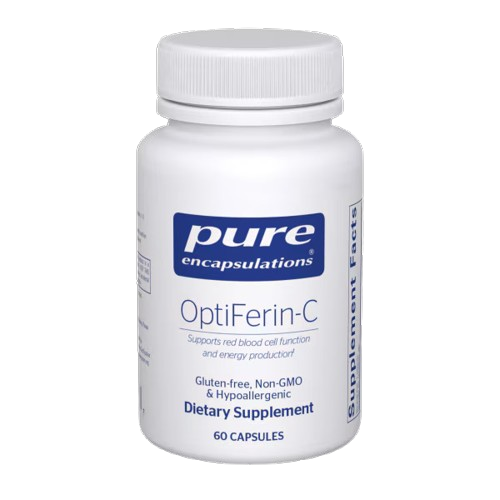
Pure Encapsulations - OptiFerin-C
Chelated bisglycinate paired with 100 mg of vitamin C in every capsule, designed for steady daily repletion.
- Elemental iron28 mg per capsule
- FormFerrous bisglycinate
- Also containsVitamin C 100 mg (calcium ascorbate)
- Take1 capsule daily
- you want a well-absorbed form with vitamin C already included
- you have experienced stomach problems with ferrous sulfate
- you need the highest possible dose per capsule
- you prefer a pharmacy-brand tablet
Pure Encapsulations pairs 28 mg of ferrous bisglycinate with 100 mg of vitamin C as calcium ascorbate, a buffered form that is gentler on the stomach than straight ascorbic acid. The bisglycinate chelate is well studied for tolerability, and the built-in vitamin C removes the need to take a separate cofactor to boost absorption.
At 156 percent of the RDA for adult women, the dose is practical for daily repletion without the high amounts that commonly trigger nausea or constipation. Buyers consistently report minimal stomach discomfort, and the capsule is free from major allergens, gluten and GMOs. The 60-capsule bottle covers two months of daily use.
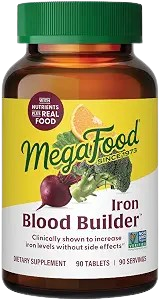
MegaFood - Blood Builder
A food-state formula combining fermented iron with folate, B12 and beetroot to support the full blood-building process.
- Elemental iron26 mg per tablet
- FormFermented ferrous bisglycinate
- Also containsVitamin C 15 mg, Folate 680 mcg DFE, B12 30 mcg
- Organic beetroot125 mg
- Take1 tablet daily
- you want iron alongside folate and B12 in one tablet
- you prefer a food-state supplement
- you want a simple iron-only formula
- you need a very high repletion dose
MegaFood Blood Builder takes a broader approach than a standalone iron pill. Its 26 mg of fermented ferrous bisglycinate is paired with folate (680 mcg DFE) and B12 (30 mcg), two nutrients your body needs alongside iron to produce healthy red blood cells. The added 125 mg of organic beetroot supplies natural nitrates.
The fermentation process embeds the iron in a food matrix, which may contribute to the strong tolerance profile buyers report. Amazon reviews consistently highlight that this tablet rarely causes the stomach upset associated with conventional iron salts. The one-tablet daily dose keeps things simple, though the lower vitamin C content (15 mg) means you may want to pair it with a vitamin-C-rich food or drink.
Where to buy
Prices change often, so we don't show them here: check the retailer for today's price.
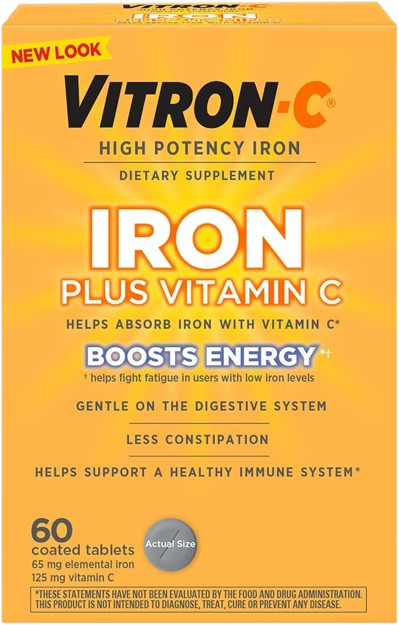
Vitron-C
The highest elemental dose on this list at 65 mg, using carbonyl iron for a lower overdose risk than traditional iron salts.
- Elemental iron65 mg per tablet
- FormCarbonyl iron
- Also containsVitamin C 125 mg (ascorbic acid)
- Take1 tablet daily
- you need a high elemental dose to rebuild stores quickly
- you want the lower overdose risk of carbonyl iron
- you take a proton pump inhibitor or have low stomach acid
- you prefer a gentler chelated form
Vitron-C delivers 65 mg of elemental iron as carbonyl iron, the highest dose on this list. Carbonyl iron is a distinct form: nonionic, highly pure metallic iron particles that are slowly converted by stomach acid rather than dissolving immediately like a salt. This slower release gives carbonyl iron a lower acute overdose toxicity than ferrous sulfate or fumarate, a meaningful safety advantage in households with young children.
The 125 mg of vitamin C as ascorbic acid supports absorption and helps compensate for the slower conversion process. Buyer feedback is mixed on tolerance: some find it gentler than ferrous sulfate at a comparable dose, while others report similar GI effects. Because carbonyl iron relies on stomach acid for conversion, it may be less effective for people who take proton pump inhibitors or have naturally low gastric acidity.
Where to buy
Prices change often, so we don't show them here: check the retailer for today's price.
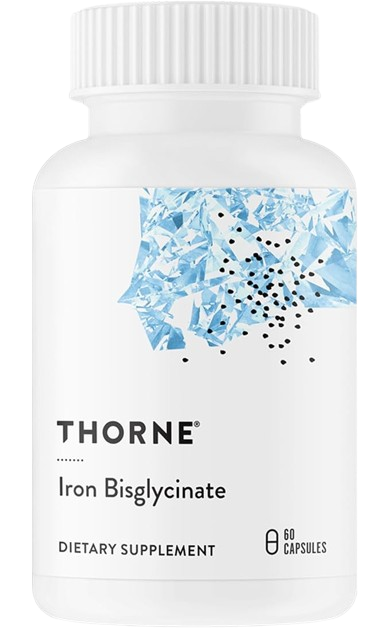
Thorne - Iron Bisglycinate
A clean Ferrochel formula at 25 mg, trusted for its tolerability and third-party testing.
- Elemental iron25 mg per capsule
- FormFerrous bisglycinate (Ferrochel)
- Other ingredientsLeucine, microcrystalline cellulose
- Take1 capsule daily
- stomach comfort is your top priority
- you want a clean, minimal-ingredient formula
- your doctor has recommended a dose above 25 mg
- you want vitamin C included in the capsule
Thorne uses the patented Ferrochel form of ferrous bisglycinate, which has been the subject of multiple tolerability and absorption studies. At 25 mg of elemental iron per capsule (139 percent of the RDA for adult women), it sits at the lower end of repletion dosing, better suited to mild deficiency or maintenance after initial repletion than to aggressive store-building.
Where Thorne excels is tolerance. Buyers across multiple retailers consistently praise the lack of stomach discomfort compared with ferrous sulfate. The capsule is small, vegan-friendly and free from major allergens. If you need a higher dose for faster repletion, you could take two capsules a day (50 mg total), but discuss that with your doctor first.
Where to buy
Prices change often, so we don't show them here: check the retailer for today's price.
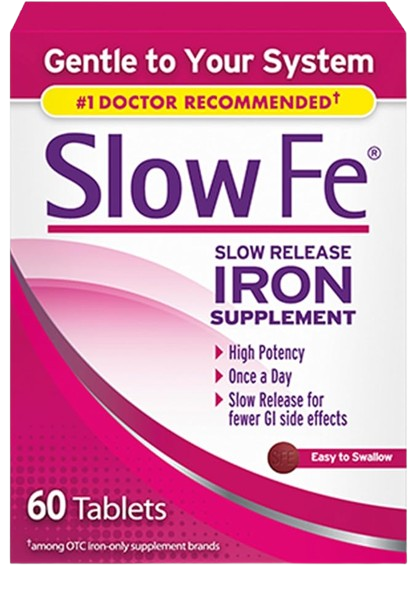
Slow Fe
Ferrous sulfate in a slow-release matrix that meters out 45 mg of iron gradually through the GI tract.
- Elemental iron45 mg per tablet
- FormSlow-release ferrous sulfate
- Take1 tablet daily
- Pack30 tablets
- your doctor prescribed ferrous sulfate and you want to reduce stomach upset
- you prefer a widely available pharmacy brand
- ferrous sulfate has caused you significant stomach problems before
- you want the best absorption per milligram
Slow Fe wraps ferrous sulfate in a slow-release matrix designed to dissolve iron gradually as the tablet moves through the digestive tract. The idea is to reduce the localized irritation that a fast-dissolving tablet can cause in the upper gut. At 45 mg of elemental iron, the dose is clinically meaningful for repletion.
The trade-off is that some research suggests slow-release forms may have lower overall absorption because a portion of the iron is released past the duodenum, where most uptake occurs. Buyer reviews are divided: many report fewer side effects than with standard ferrous sulfate, while others see little difference. The 30-tablet pack lasts only one month, so expect to restock more frequently than with larger bottles.
Where to buy
Prices change often, so we don't show them here: check the retailer for today's price.
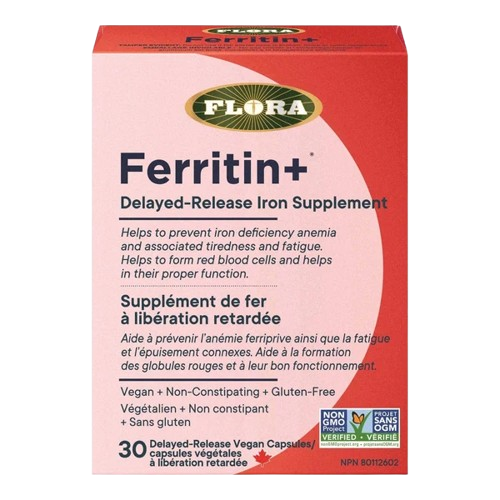
Flora - Ferritin+
Iron stored naturally inside pea ferritin protein, delivered in a delayed-release vegan capsule.
- Elemental iron20 mg per capsule
- FormIron from pea ferritin
- FormatDelayed-release vegan capsule
- Take1 capsule daily
- you follow a vegan diet and want a plant-native iron source
- bisglycinate still causes you stomach discomfort
- you need rapid repletion at a higher dose
- the limited long-term clinical data concerns you
Flora Ferritin+ takes a fundamentally different approach. Instead of a synthetic iron salt or chelate, it delivers iron stored inside pea ferritin protein, the same way plants naturally store the mineral. The theory is that the ferritin shell protects iron through the stomach and releases it in the small intestine via endocytosis, bypassing many of the factors that block conventional iron absorption.
At 20 mg per capsule, the dose is modest for repletion, and long-term clinical trials comparing pea ferritin with established forms remain limited. Early research is promising, and tolerance is excellent according to buyer reports. The delayed-release capsule adds another layer of GI protection. The main limitation: this is one of the pricier options on the list, and people with severe deficiency may find the dose insufficient on its own.
Who should avoid iron supplements
Get a blood test before you startDo not take an iron supplement without a <strong>blood test confirming low ferritin or iron deficiency</strong>. Excess iron accumulates in organs and can cause serious harm, particularly in people with <strong>hemochromatosis</strong> or other iron-loading conditions. Iron can interact with thyroid medication, tetracycline antibiotics and antacids. <strong>Keep iron supplements out of reach of children</strong>: accidental overdose of iron-containing products is a leading cause of fatal poisoning in children under six.
Iron supplements are not for everyone. People with hemochromatosis or other iron-loading conditions should not take supplemental iron unless directed by a specialist. If you receive regular blood transfusions, extra iron is likely the opposite of what you need.
Several medications interact with iron. Levothyroxine (thyroid hormone), tetracycline and quinolone antibiotics, levodopa and certain bisphosphonates all require a gap of at least two to four hours from your iron dose. Check with your doctor or pharmacist before combining iron with any prescription medication.
Frequently asked questions
How long does it take to raise ferritin with supplements?
Most people see hemoglobin improvements within four to six weeks. Rebuilding ferritin stores takes longer, typically three to six months of consistent supplementation. Your doctor can track progress with a blood test after 8 to 12 weeks. If ferritin has not improved by then, the dose, form or timing may need adjusting.
What ferritin level is considered low?
The World Health Organization defines iron depletion as ferritin below 15 micrograms per liter. Many doctors use a working cutoff of 30 micrograms per liter because fatigue, hair thinning and poor concentration can appear above the WHO threshold.
Is it better to take iron every day or every other day?
Research by Stoffel et al. (2020) suggests that alternate-day dosing may improve absorption per dose because it allows hepcidin levels to fall between doses. This approach can also reduce side effects. Discuss it with your doctor before switching from a prescribed daily regimen.
Can you raise ferritin without taking supplements?
It is possible through iron-rich foods such as red meat, poultry, lentils and fortified cereals, but diet alone is slow to correct a genuine deficiency. If your ferritin is below 30, most doctors will recommend a supplement alongside dietary changes to close the gap in a reasonable timeframe.
Should I take iron with food or on an empty stomach?
Iron is generally absorbed best on an empty stomach, 30 to 60 minutes before eating. If that causes nausea, a small snack is a reasonable trade-off. Carbonyl iron and plant ferritin absorb reasonably well with food because they rely on different uptake mechanisms than conventional iron salts.
The bottom line
Rebuilding low ferritin takes the right supplement, the right dose and enough time. For most people, a chelated bisglycinate with added vitamin C offers the best balance of absorption and comfort. If you need a higher dose for faster repletion, carbonyl iron delivers 65 mg with a better safety profile than traditional ferrous sulfate. And if stomach tolerance is everything, pea ferritin or a minimal bisglycinate may be worth the lower dose.
Whichever supplement you choose, get a blood test first, pair your iron with vitamin C, keep it away from tea and coffee, and follow up with your doctor after two to three months to make sure your stores are heading in the right direction.
Pure Encapsulations - OptiFerin-C
- 28 mg chelated bisglycinate per capsule
- 100 mg vitamin C (calcium ascorbate) built in
- Excellent tolerance and buyer feedback

Independent guides to natural remedies and supplements, checked against NHS and EFSA references.