Home › Natural Remedies › What are flower remedies, and do they work?
Natural RemediesWhat are flower remedies, and do they work?
Quick answerFlower remedies are a traditional practice developed in the 1930s. Reviews of the clinical evidence have found no good-quality proof that they work beyond a placebo effect.
They are generally considered safe, but they contain <strong>brandy</strong> as a preservative, which is worth knowing if you are pregnant, giving them to a child, or avoiding alcohol. If you have symptoms that worry you, see your GP rather than relying on a flower remedy.
Flower remedies sit in an unusual corner of complementary therapy. They have been around for nearly a century, they are widely available in chemists and health food shops across the UK, and many people swear by them for stress, low mood and everyday emotional ups and downs. At the same time, the clinical research that exists paints a consistent picture: no reliable trial has found them more effective than a placebo.
That does not mean the conversation ends there. Understanding what flower remedies are, where they come from, and what the science actually says puts you in a much better position to decide whether they belong in your life.
What are flower remedies?
Flower remedies, sometimes called flower essences or Bach flower remedies, are a set of 38 liquid preparations developed in the 1930s by Dr Edward Bach, a British physician and bacteriologist. Bach believed that negative emotional states such as fear, loneliness and uncertainty were at the root of physical illness, and that the energy of certain wild flowers could help restore emotional balance.
Each of the 38 remedies is linked to a specific emotional state. Bach grouped them into seven broad categories: fear, uncertainty, insufficient interest in the present, loneliness, oversensitivity, despondency or despair, and excessive concern for others. For example, Mimulus is associated with fear of known things, while Olive is linked to exhaustion.
Bach also created a combination blend of five remedies intended for moments of acute stress or shock. Five-flower blends are now sold under several brand names and remain the most widely recognised flower remedy product.
How are they made?
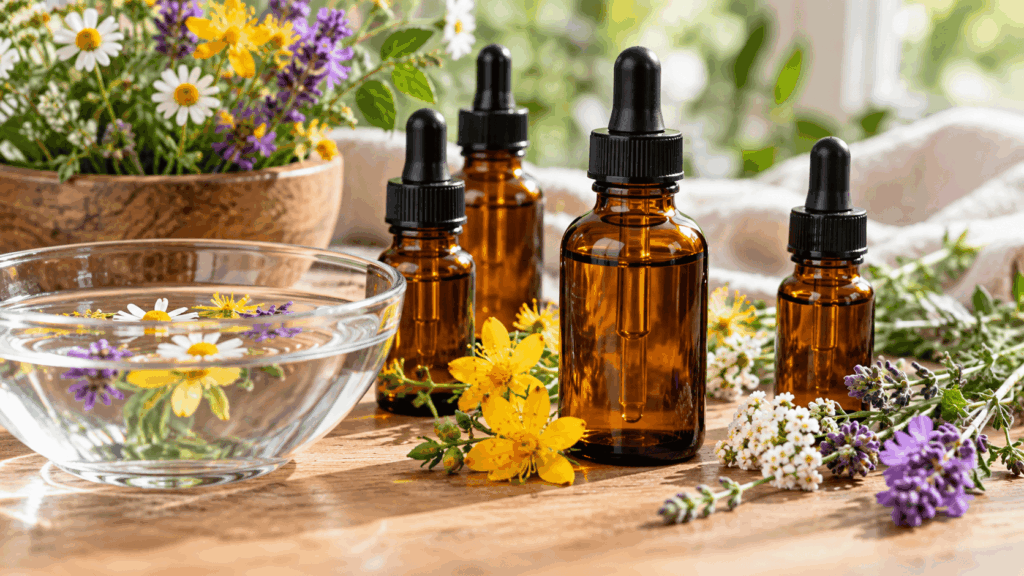
Flower remedies are prepared using one of two methods Bach described: the sun method and the boiling method. In the sun method, freshly picked flowers are placed in a bowl of natural spring water and left in direct sunlight for several hours. In the boiling method, flowers and plant material are simmered in spring water for around half an hour.
After either process, the flowers are filtered out and the remaining liquid, called the mother tincture, is preserved with brandy. The final product is then diluted further before it is bottled. By the time a remedy reaches the shelf, it contains no measurable amount of the original flower. Unlike herbal tinctures, which contain active plant compounds, flower remedies rely on what practitioners describe as the flower’s vibrational energy captured in the water.
Flower remedies are not herbal medicineHerbal medicines such as valerian or St John's wort contain measurable plant compounds that can interact with the body. Flower remedies do not. They are closer in concept to homeopathy, though they use a different preparation method and are not classified as homeopathic medicines in the UK.
Do flower remedies work? What the research says
Two systematic reviews have looked specifically at the clinical evidence for flower remedies, and both reached the same conclusion.
A 2009 systematic review by Thaler and colleagues examined four randomised controlled trials (three on examination anxiety and one on ADHD in children) and found no evidence of benefit compared with a placebo. A 2010 systematic review by Edzard Ernst at the University of Exeter identified seven randomised clinical trials in total. All of the placebo-controlled trials failed to show any difference between flower remedies and a placebo.
Cancer Research UK states plainly that there is no scientific evidence flower remedies can control, cure or prevent any type of disease.
The NHS does not recommend homeopathy (the closest recognised category to flower remedies) for any health condition. The National Institute for Health and Care Excellence (NICE) takes the same position.
How strong is the evidence?The evidence is limited in both directions. Only a handful of well-designed trials exist, and they are small. What they consistently show is that people given a placebo improve at the same rate as people given a flower remedy. This does not prove flower remedies are useless (many people report feeling better), but it does suggest any benefit is likely down to the placebo response, the ritual of self-care, or the passage of time rather than the remedy itself.
Why do people keep using them?
If the trials say flower remedies perform no better than placebo, why do they remain popular? A few things probably play a role. The consultation process itself (sitting down, reflecting on how you feel, choosing a remedy) can be genuinely therapeutic. It encourages a kind of emotional self-awareness that many people find helpful, regardless of what is in the bottle.
There is also the placebo effect, which is real and measurable. If you believe something will help and the act of taking it is calming, you may genuinely feel better. That is not the same as the remedy having a pharmacological effect, but it is not nothing either.
Flower remedies also carry very low risk. Unlike some herbal supplements, they do not contain active plant compounds that could interact with medication. For people who find comfort in them alongside conventional care, the main concern is whether they might be used instead of proper medical help when it is needed.
Are flower remedies safe?
Flower remedies are generally considered safe for most adults. Because they contain no measurable active ingredient, the risk of a pharmacological side effect is extremely low. They do not interact with prescribed medicines in the way that herbal products such as St John’s wort can.
The main practical concern is alcohol content. Most flower remedies are preserved in brandy, which means every dose contains a small amount of alcohol. This matters if you are pregnant, breastfeeding, giving a remedy to a child, taking medication that interacts with alcohol, or avoiding alcohol for personal or health reasons. Some producers now offer alcohol-free versions preserved in vegetable glycerine.
Talk to your GP, midwife or pharmacist ifYou are pregnant or breastfeeding and considering a flower remedy (because of the alcohol content). You are thinking of giving a flower remedy to a child: check with your pharmacist or health visitor first. You have been feeling persistently low, anxious or unable to cope for more than two weeks. These are signs to seek proper support, not to self-treat with an unproven remedy. You are using a flower remedy instead of a treatment your GP has recommended.
When to seek proper support
Flower remedies are sometimes marketed for stress, anxiety and low mood. These are real problems that deserve real attention. If any of the following apply, speak to your GP rather than reaching for a flower remedy:
- You feel persistently anxious or low for more than two weeks
- Your mood is affecting your sleep, appetite or daily life
- You have thoughts of self-harm: call your GP, NHS 111, or the Samaritans on 116 123 (available 24 hours a day)
- You have unexplained physical symptoms such as ongoing fatigue, dizziness or weight loss. These need investigating, not a flower remedy
In an emergency, call 999 or go to A&E.
Common questions about flower remedies
Are Bach flower remedies the same as essential oils?
No. Essential oils are concentrated plant extracts with a strong scent and measurable chemical compounds. Flower remedies contain no detectable plant material and have no fragrance. They are made by a completely different process (steeping flowers in water and preserving the liquid in brandy) and are taken by mouth, whereas essential oils are typically inhaled or applied to the skin.
Can children take flower remedies?
Most flower remedies contain brandy as a preservative, so they are not ideal for young children. Some producers offer alcohol-free versions preserved in glycerine. If you are considering a flower remedy for a child, check the label and speak to your pharmacist or health visitor first. For any ongoing emotional or behavioural concern in a child, your GP is the right starting point.
Are flower remedies the same as homeopathy?
They share some similarities (both involve highly diluted preparations and both lack strong clinical evidence) but they are not the same thing. Homeopathic remedies follow the principle that a substance causing symptoms in a healthy person can treat similar symptoms in a sick person, and they use serial dilution and succussion. Flower remedies use a simpler preparation method and are based on the idea that each flower addresses a specific emotional state. In the UK, flower remedies are not classified as homeopathic medicines.
How many Bach flower remedies are there?
Dr Edward Bach identified 38 individual remedies, each linked to a specific emotion or emotional pattern. He also created one combination formula (a blend of five remedies) for acute stress. Since then, producers around the world have developed hundreds of additional flower and plant essences, but the original 38 Bach remedies remain the most widely known and used.
Can you use flower remedies alongside conventional medicine?
Because flower remedies contain no active plant compounds, they are not known to interact with prescribed medication. However, it is always worth mentioning any complementary therapy to your GP or pharmacist, especially if you are being treated for a mental health condition. The concern is not the remedy itself but the possibility of relying on it instead of evidence-based treatment.

Independent guides to natural remedies and supplements, checked against NHS and EFSA references.