Home › Best Supplements › What is the best iron supplement for men?
RankingsWhat is the best iron supplement for men?
We may earn a commission when you buy through links on this page. No brand pays to be ranked. How we rank products

Most men get all the iron they need from food. The recommended dietary allowance for adult men sits at just 8 mg a day, roughly half of what premenopausal women need, and a balanced diet usually covers it. So why would a man reach for an iron supplement?
Because some men fall short. Regular blood donors, endurance athletes, men following a plant-based diet, and anyone with a diagnosed gastrointestinal condition that limits absorption can develop low iron stores without realizing it. A blood test showing low ferritin is the clearest signal, and a doctor can rule out causes that need separate treatment.
We compared over a dozen iron supplements available in the US, checked every label against its official listing, read through hundreds of buyer reviews, and scored five picks on form, dose, tolerance and real-world feedback. Below, we explain what actually matters when choosing iron as a man, then walk through each product in detail.
A gentle bisglycinate at 25 mg suits most men with confirmed low iron.
Our top pick is Thorne – Iron Bisglycinate, an NSF-certified capsule that delivers 25 mg of elemental iron in a well-tolerated form. If you want built-in vitamin C for absorption, consider Pure Encapsulations – OptiFerin-C.
Why men rarely need extra iron, and when they do
Iron is essential for making hemoglobin, the protein in red blood cells that carries oxygen to every tissue. The body also uses it for energy metabolism, immune function, and cognitive performance. According to the NIH Office of Dietary Supplements, iron contributes to the normal formation of red blood cells and hemoglobin, and it contributes to the reduction of tiredness and fatigue.
Men lose very little iron day to day. Unlike women, who lose iron through menstruation, most men maintain adequate stores through diet alone. That makes routine supplementation unnecessary for the average man, and potentially risky. The tolerable upper intake level is 45 mg a day for healthy adults; going above that without medical supervision can cause nausea, constipation, and longer-term iron accumulation.
Several groups of men do fall short:
- Frequent blood donors lose roughly 200-250 mg of iron per donation, and regular donors can deplete stores within a few cycles.
- Endurance athletes may develop what researchers call exercise-related iron deficiency, partly from foot-strike hemolysis and increased iron losses through sweat.
- Men with GI conditions such as celiac disease, inflammatory bowel disease, or chronic use of proton pump inhibitors may absorb less iron from food.
- Vegetarians and vegans rely on non-heme iron, which the body absorbs less efficiently than heme iron from meat.
Iron supplements are not something to take "just in case." Ask your doctor for a ferritin test before starting. Men with undiagnosed hemochromatosis, a genetic condition affecting roughly 1 in 225 people of Northern European ancestry, can accumulate dangerous levels of iron. Symptoms often appear after age 40 and include joint pain, fatigue, and skin darkening.
Iron supplement forms: what actually matters
Not all iron supplements are the same compound. The form determines how well the iron is absorbed, how likely it is to upset your stomach, and whether you need to take it on an empty stomach. Here is what the research says about the four forms you will find on shelves.
Iron bisglycinate (chelated iron)
Iron bisglycinate is iron bonded to two molecules of the amino acid glycine. This chelation partly shields it from dietary inhibitors like phytates and tannins, which means you can take it with food without losing as much absorption. A 2023 systematic review in Nutrition Reviews (Fischer et al.) found that bisglycinate raised hemoglobin comparably to other forms while producing roughly a third as many GI complaints in pregnancy trials. It is the form used in most of the gentle-iron products on the market.
Ferrous sulfate
Ferrous sulfate is the most studied and most prescribed form. It delivers a high dose of elemental iron per tablet, typically 45-65 mg, making it the go-to for diagnosed iron deficiency anemia. The downside is tolerability: a 2024 AGA clinical review (DeLoughery et al.) reported GI side-effect rates of 25-75% depending on dose. Constipation, nausea, and dark stools are the most common complaints.
Slow-release ferrous sulfate
Slow-release tablets use a controlled-delivery matrix to release ferrous sulfate gradually along the digestive tract. The idea is to reduce peak iron concentration in the stomach, which can lower nausea and cramping. In practice, some of the iron is released past the duodenum, where absorption is less efficient. This trade-off suits men who need a higher dose but struggle with standard ferrous sulfate.
Fermented iron bisglycinate (whole-food iron)
Some brands ferment iron bisglycinate with whole foods like organic beetroot and broccoli. The fermentation process is designed to improve bioavailability and deliver co-factors such as folate, B12 and vitamin C alongside the iron. The clinical evidence behind whole-food iron specifically is limited, but the underlying form is still bisglycinate.
A label saying "325 mg ferrous sulfate" does not mean 325 mg of iron. Ferrous sulfate is about 20% elemental iron, so that tablet delivers roughly 65 mg. Always check the "elemental iron" figure in the Supplement Facts panel. That is the number that counts against the RDA and upper limit.
Choosing the right dose as a man
The RDA for men aged 19 and over is 8 mg of iron per day, counting food and supplements together. Most iron supplements deliver far more than that, from 18 mg in low-dose capsules to 65 mg in prescription-strength tablets. The gap between need and dose is wider for men than for any other adult group.
For mild deficiency confirmed by blood work, a moderate dose of 18-28 mg of elemental iron is usually enough to rebuild stores over two to three months. For diagnosed iron deficiency anemia, doctors typically prescribe 45-65 mg daily, sometimes for longer. A 2017 study published in The Lancet Haematology (Stoffel et al.) found that taking iron every other day produced comparable ferritin repletion to daily dosing, with better tolerability.
Take your iron capsule with a glass of orange juice or another source of vitamin C. Avoid tea, coffee and calcium-rich foods within two hours of your dose. These inhibit non-heme iron absorption.

How we scored
We evaluated each supplement on four criteria, weighted to reflect what matters most when choosing iron as a man. Every spec was verified against the product label or official listing, and every buyer quote comes from a named review platform.
- Dose & form (35%) – Is the iron form well-absorbed? Does the dose suit a man with confirmed low iron without overshooting the 45 mg upper limit?
- Tolerance (25%) – How likely is it to cause constipation, nausea or stomach discomfort, based on the form and real-world feedback?
- Value (20%) – Cost per day and pack size, without displaying prices (these change frequently).
- Buyer feedback (20%) – What verified buyers say on Amazon, Walmart and iHerb, weighted toward stomach-related comments and effectiveness.
Scores run from 0 to 10, rounded to one decimal place, and decrease strictly from our top pick to our fifth. Full methodology: how we rank products.
Our ranking at a glance
| Rank | Product | Form & dose | Score | |
|---|---|---|---|---|
| #1Best overall | Thorne - Iron Bisglycinate | Iron bisglycinate capsule 25 mg elemental iron | 8.8/10 | Check price |
| #2Best value | Solgar - Gentle Iron | Iron bisglycinate chelate capsule 25 mg elemental iron | 8.5/10 | Check price |
| #3Best with vitamin C | Pure Encapsulations - OptiFerin-C | Iron bisglycinate capsule 28 mg elemental iron | 8.3/10 | Check price |
| #4Best slow-release | Slow Fe | Ferrous sulfate slow-release tablet 45 mg elemental iron | 8.0/10 | Check price |
| #5Best whole-food formula | MegaFood - Blood Builder | Fermented iron bisglycinate tablet 26 mg elemental iron | 7.8/10 | Check price |
Our picks reviewed
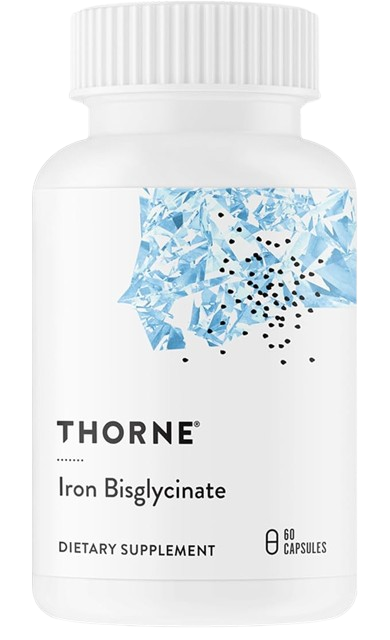
Thorne - Iron Bisglycinate
A clean, well-dosed bisglycinate backed by NSF certification and strong buyer reviews.
- Elemental iron25 mg per capsule
- Formiron bisglycinate
- Capsule typevegetarian
- CertificationsNSF Certified for Sport, NSF/ANSI 173
- you want a gentle, well-tested daily iron
- you are an athlete who needs NSF-certified supplements
- your doctor prescribed a higher dose for anemia
- you prefer a formula with added vitamin C
Thorne’s bisglycinate capsule delivers 25 mg of elemental iron in a form that is consistently praised for stomach comfort. The NSF Certified for Sport mark means the product is independently tested for banned substances, which matters if you compete or simply want third-party assurance. Each bottle holds 60 capsules, enough for two months at one capsule a day.
Verified buyers on Walmart describe it as “easy on our stomachs” (L., Walmart) and “recommended by hematologist for better absorption” (H., Walmart). The dose sits comfortably below the 45 mg upper limit while still being high enough to correct a mild deficiency over eight to twelve weeks. The capsule is small and easy to swallow. The only real limitation is the absence of added vitamin C, so you may want to pair it with a glass of orange juice.
Where to buy
Prices change often, so we don't show them here: check the retailer for today's price.
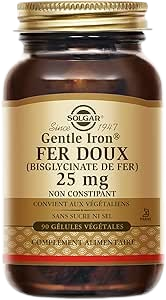
Solgar - Gentle Iron
Six months of gentle bisglycinate in a single bottle, with vegan and kosher certification.
- Elemental iron25 mg per capsule
- Formiron bisglycinate chelate
- Capsule typevegetable
- Free fromgluten, wheat, dairy, soy
- CertificationsNon-GMO, Kosher Parve
- you want the lowest cost per day without switching to ferrous sulfate
- you follow a vegan or kosher diet
- you need third-party sport certification
- you prefer a smaller bottle to try first
Solgar's Gentle Iron matches Thorne on form and dose, 25 mg of iron bisglycinate chelate per vegetable capsule, but stands out on pack size. The 180-count bottle delivers a full six months, which brings the daily cost well below most competitors. It is certified vegan, kosher parve, gluten-free, and free from dairy, soy and sugar.
On Walmart, one verified buyer called it "gentle on stomach as advertised" (Walmart customer). Solgar's main drawback compared to Thorne is the lack of third-party sport certification. If you are not an athlete and simply need a reliable daily iron at a competitive cost, the 180-capsule bottle is hard to beat for long-term use. The capsule contains no artificial colors or flavors.
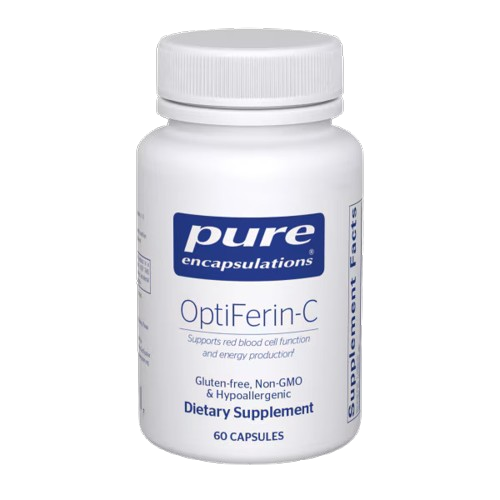
Pure Encapsulations - OptiFerin-C
Iron bisglycinate paired with 100 mg of vitamin C for better absorption, in a hypoallergenic capsule.
- Elemental iron28 mg per capsule
- Vitamin C100 mg (ascorbate blend)
- Formiron bis-glycinate
- Capsule typevegetarian
- Free fromgluten, GMOs, common allergens
- you want iron and vitamin C in one capsule
- you have food sensitivities or allergies
- you are on a tight budget
- 28 mg is more than your doctor recommended
Pure Encapsulations combines 28 mg of iron bisglycinate with 100 mg of vitamin C from a calcium ascorbate blend. Vitamin C is a well-established enhancer of non-heme iron absorption, so bundling them removes one variable from your routine. The brand's hypoallergenic pledge means the capsule is free from gluten, dairy, soy, eggs, peanuts, and common fillers.
On iHerb, a verified buyer wrote "gentle on the stomach which is a must for me" (NikolSilver, iHerb), and another reported that "iron stores went from 7 to 19" after using it alongside blood monitoring (iHerb customer). The 60-capsule bottle lasts two months. The trade-off is cost: OptiFerin-C sits at the premium end of the market, which is reflected in the lower value score.
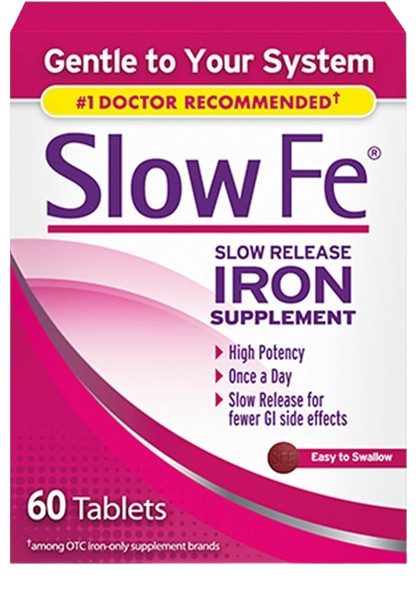
Slow Fe
A higher-dose option for men with diagnosed anemia who struggle with regular ferrous sulfate.
- Elemental iron45 mg per tablet
- Formferrous sulfate (slow-release matrix)
- Tablet typecoated, swallow whole
- Pack sizes30 or 60 tablets
- your doctor has prescribed a higher iron dose
- regular ferrous sulfate upsets your stomach
- you have mild deficiency and do not need 45 mg
- you prefer a non-sulfate form
Slow Fe delivers 45 mg of elemental iron from ferrous sulfate through a controlled-release system designed to reduce the stomach irritation that standard ferrous sulfate tablets are known for. At 45 mg, it sits right at the tolerable upper limit, so this is a supplement for men with diagnosed iron deficiency anemia under medical guidance, not for mild or preventive use.
The product carries a 4.7 out of 5 rating from over 2,600 reviews on Walmart, suggesting broad satisfaction. The slow-release mechanism does help with tolerability compared to instant-release ferrous sulfate, but some absorption occurs past the duodenum, where uptake is lower. If your doctor has asked you to take 45-65 mg daily, Slow Fe is a widely available, affordable option that most men find easier to stick with than generic ferrous sulfate tablets.
Where to buy
Prices change often, so we don't show them here: check the retailer for today's price.
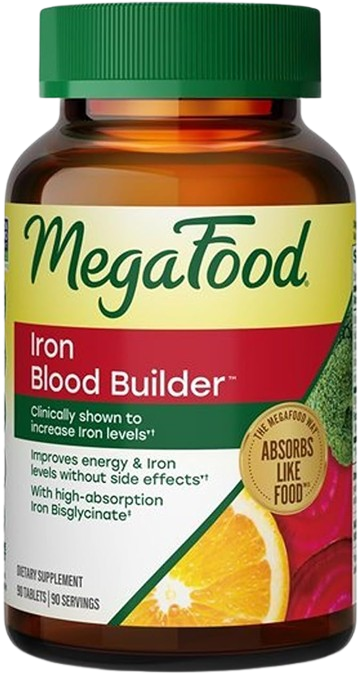
MegaFood - Blood Builder
A fermented iron tablet with B12, folate and vitamin C for men who want more than iron alone.
- Elemental iron26 mg per tablet
- Vitamin C15 mg
- Folate680 mcg DFE
- Vitamin B1230 mcg
- Otherorganic beetroot 125 mg
- CertificationsNon-GMO, Certified Vegan, Certified B Corp
- you want iron alongside B12 and folate in one tablet
- you prefer whole-food-based supplements
- you only need iron and want a simpler formula
- the B12 dose (1,250% DV) feels excessive for your situation
MegaFood's Blood Builder takes a different approach: it pairs 26 mg of fermented iron bisglycinate with folate, B12 and vitamin C, plus organic beetroot. The idea is to support overall red blood cell production rather than simply adding iron. It is certified vegan, Non-GMO Project Verified and produced by a B Corporation.
The formula suits men whose blood work shows low iron alongside low B12 or folate, which can happen on a plant-based diet. Buyer feedback on third-party sites frequently highlights the absence of digestive complaints. The main drawback is that the B12 dose sits at 1,250% of the daily value, which is unnecessary if your B12 is already normal, and the whole-food approach makes it pricier per day than a straightforward bisglycinate capsule.
Where to buy
Prices change often, so we don't show them here: check the retailer for today's price.
When to skip iron supplements
Iron is not a nutrient to take without reason. Unlike water-soluble vitamins, excess iron accumulates in the body and can damage organs over time. The following situations call for caution or avoidance.
You have not had a blood test confirming low iron or low ferritin. You have been diagnosed with hemochromatosis or any iron-loading condition. You are taking medications that interact with iron, including certain antibiotics (tetracyclines, quinolones), thyroid medication (levothyroxine), or antacids. Always tell your doctor about every supplement you take.
Hemochromatosis deserves particular attention in men. According to the National Institute of Diabetes and Digestive and Kidney Diseases, men are more likely than women to develop symptomatic iron overload, and symptoms often do not appear until after age 40. If you have Northern European ancestry, ask your doctor whether genetic screening is appropriate before starting any iron supplement.
Even without hemochromatosis, long-term unsupervised iron use can push ferritin above the healthy range. A follow-up blood test after eight to twelve weeks of supplementation is standard practice. Once stores are replenished, most men can stop and maintain levels through diet.
Common questions about iron for men
How much iron does a man need per day
The recommended dietary allowance for men aged 19 and over is 8 mg per day, according to the NIH Office of Dietary Supplements. This includes iron from food and supplements combined. Most men meet this through diet alone.
Can too much iron be harmful for men
Yes. The tolerable upper intake level is 45 mg per day for healthy adults. Exceeding this regularly can cause nausea, constipation and, over time, iron accumulation that damages the liver, heart and pancreas. Men are at higher risk than premenopausal women because they do not lose iron through menstruation.
Should I take iron every day or every other day
Research suggests both approaches can work. A 2017 study in The Lancet Haematology found that alternate-day dosing produced comparable ferritin repletion with fewer side effects. Your doctor can advise based on how low your levels are.
What are the signs of low iron in men
Common signs include persistent fatigue, shortness of breath during exercise, pale skin, brittle nails, and difficulty concentrating. These overlap with many other conditions, so a blood test is the only reliable way to confirm iron deficiency.
Is bisglycinate really easier on the stomach than ferrous sulfate
The evidence points that way. A 2023 meta-analysis in Nutrition Reviews found that bisglycinate produced roughly a third as many GI complaints as other iron forms in clinical trials, while raising hemoglobin to a similar extent.
The bottom line
Most men do not need an iron supplement. But if a blood test confirms low ferritin or iron deficiency, a well-chosen bisglycinate capsule can rebuild stores with minimal side effects. Start with a moderate dose, take it with vitamin C, and retest after two to three months.
Thorne - Iron Bisglycinate
- 25 mg iron bisglycinate per capsule
- NSF Certified for Sport
- Well tolerated according to buyer reviews

Independent guides to natural remedies and supplements, checked against NHS and EFSA references.