Home › Best Supplements › What is the best iron supplement for kids?
RankingsWhat is the best iron supplement for kids?
We may earn a commission when you buy through links on this page. No brand pays to be ranked. How we rank products

Iron deficiency is the most common nutritional deficiency in children in the United States, according to the NIH Office of Dietary Supplements. Left unaddressed, it can slow growth, affect concentration in school, and lead to iron deficiency anemia. Yet picking the right supplement is harder than it sounds: liquid drops, chewables, gummies, and dissolvable tablets all claim to be kid-friendly, and the iron forms inside them range from gentle carbonyl iron to harsher ferrous salts.
We looked at more than 20 children’s iron supplements available in the US, checked every label against the NIH recommended daily allowances, and scored each one on form, dose, tolerance, value, and real parent feedback. Below, we explain the forms, walk through dosing by age, and review the five that scored highest.
For most kids, a polysaccharide iron complex or carbonyl iron supplement is the safest starting point.
Our top pick is NovaFerrum – Yummy Pediatric Drops for babies and toddlers. For children aged 2 and up who can chew, Renzo's – Iron Strong dissolves on the tongue without any swallowing struggle.
Why iron matters for growing children
Iron is essential for making hemoglobin, the protein in red blood cells that carries oxygen around the body. In children, that oxygen fuels everything from brain development to physical growth. The NIH notes that iron also contributes to normal cognitive development in children, a claim backed by the nutrient’s role in myelination and neurotransmitter synthesis.
Children are especially vulnerable to low iron for a few reasons. Rapid growth increases demand, and many young children are picky eaters who avoid iron-rich foods such as red meat, beans, and fortified cereals. The NIH fact sheet flags infants, young children, and adolescent girls as groups at higher risk.
The recommended daily allowances for iron change with age:
- 7 to 12 months: 11 mg
- 1 to 3 years: 7 mg
- 4 to 8 years: 10 mg
- 9 to 13 years: 8 mg
- 14 to 18 years: boys 11 mg, girls 15 mg
The tolerable upper intake level (UL) for children under 14 is 40 mg per day from all sources combined, including food (NIH). Going above that raises the risk of nausea, constipation, and in extreme cases, toxicity.
Accidental overdose of iron-containing products is a leading cause of fatal poisoning in children under 6 (NIH). Always store supplements in child-resistant packaging, well out of reach. If you suspect your child has swallowed too many tablets or too much liquid iron, call Poison Control (1-800-222-1222) or 911 immediately.
Iron supplement forms explained
Not all iron supplements are the same inside. The form of iron determines how well it is absorbed, how it tastes, and how likely it is to cause stomach trouble. Here is what parents need to know about the four forms found in children’s supplements.
Polysaccharide iron complex (PIC)
PIC wraps elemental iron in a sugar-based shell that dissolves slowly in the gut. It is the form most often used in prescription-grade pediatric drops, and it has a long track record in clinical settings. Because the iron releases gradually, PIC tends to cause less nausea and constipation than ferrous salts. It is well suited to infants and toddlers who need a liquid supplement.
Carbonyl iron
Carbonyl iron is pure elemental iron powder produced by decomposing iron pentacarbonyl. Its key advantage for children is safety: because it is absorbed slowly and only in an acidic environment, accidental ingestion of a large dose is far less toxic than the same amount of ferrous sulfate. A randomized trial in children under six found that carbonyl iron raised hemoglobin as effectively as ferrous sulfate at 30 days, with significantly better acceptance and fewer side effects: none of the carbonyl iron group reported vomiting, compared with 36% in the ferrous sulfate group.
Iron bisglycinate (chelated iron)
Iron bisglycinate bonds iron to the amino acid glycine, which helps it pass through the gut wall without competing with other minerals for absorption. It is generally considered gentle on the stomach and is often marketed as a good option for children with sensitive digestion. The chelated form is less well studied specifically in children than PIC or carbonyl iron, but adult data suggest absorption rates comparable to ferrous sulfate at lower doses.
Ferrous salts (sulfate, fumarate, gluconate)
Ferrous sulfate is the form most often prescribed by pediatricians for diagnosed iron deficiency anemia because it delivers a high amount of elemental iron per dose. However, it is also the form most likely to cause stomach cramps, constipation, nausea, and a metallic taste. Among the three salts, ferrous fumarate has the highest elemental iron content by weight (33%), followed by ferrous sulfate (20%) and ferrous gluconate (12%). For over-the-counter use in children, gentler forms are generally preferred.
Supplement labels can be confusing. The number that matters is elemental iron: the actual amount of iron your child absorbs. A tablet listing "65 mg ferrous sulfate" contains only about 13 mg of elemental iron. Always check the Supplement Facts panel for the elemental iron figure.
How to choose by your child’s age
Babies and toddlers (under 4)
Children under four generally need a liquid iron supplement because they cannot safely chew or dissolve a tablet. Look for a calibrated dropper so you can measure the dose precisely. Polysaccharide iron complex drops are the standard in this age group. Flavor matters enormously: a supplement your child spits out every time is not going to help, however good the iron form.
Preschoolers and school-age children (4 to 13)
Once a child can chew reliably, chewable tablets and dissolvable tabs become practical. Carbonyl iron chewables are a strong option because of their safety profile and reasonable taste. Match the dose to the child’s age bracket: 10 mg for ages 4 to 8, 8 mg for ages 9 to 13 (NIH). A supplement offering 7 to 9 mg suits most children without overshooting.
If your child has been diagnosed with iron deficiency
When a pediatrician confirms low ferritin or iron deficiency anemia through a blood test, they will often recommend a higher therapeutic dose, sometimes 3 to 6 mg of elemental iron per kg of body weight per day. In that situation, a polysaccharide iron complex supplement at 15 to 18 mg per dose, or a prescribed ferrous sulfate liquid, may be appropriate. Do not increase your child’s dose without medical advice.
Give iron with a source of vitamin C (orange juice, strawberries, bell pepper) and away from milk, calcium supplements, and antacids, which block absorption. Wait at least two hours between iron and dairy (NIH).
How we scored these supplements
We evaluated each product across four criteria, weighted to reflect what matters most for a children’s supplement. Full details of our process are on our how we rank products page.
- Dose & form (35%) — Does the iron form suit children? Is the elemental iron dose appropriate for the labeled age range, measured against the NIH RDA?
- Tolerance (25%) — How gentle is the form on small stomachs? We prioritized forms with lower side-effect profiles (carbonyl iron, PIC, bisglycinate) over ferrous salts.
- Value (20%) — Cost per day of use relative to other products in the same format, without listing specific prices.
- Buyer feedback (20%) — What do parents actually report about taste acceptance, side effects, and ease of use, drawn from verified reviews on Amazon and independent review platforms.
Scores run from 1 to 10, with the overall score being the weighted average. Every sub-score is justified by a specific fact in the review below.

The full ranking
| Rank | Product | Form & dose | Score | |
|---|---|---|---|---|
| #1Best for babies & toddlers | NovaFerrum - Yummy Pediatric Drops | Polysaccharide iron complex liquid 15 mg per mL | 8.7/10 | Check price |
| #2Best dissolvable for fussy eaters | Renzo's - Iron Strong | Carbonyl iron dissolvable tab 9 mg per tab | 8.4/10 | Check price |
| #3Cleanest ingredients | Hiya - Kids Daily Iron+ | Carbonyl iron chewable 7 mg per tab | 8.2/10 | Check price |
| #4Best for higher iron needs | NovaFerrum - YAY! Chewable | Polysaccharide iron complex chewable 18 mg per tab | 8.0/10 | Check price |
| #5Best gentle form | Carlson - Kids Chewable Iron | Iron glycinate chewable 15 mg per tab | 7.8/10 | Check price |
Our picks, reviewed
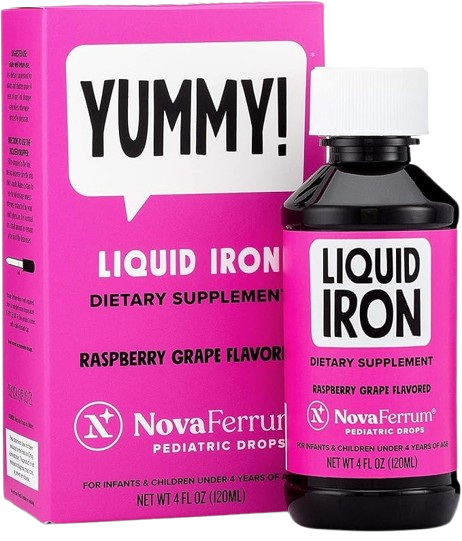
NovaFerrum - Yummy Pediatric Drops
The only liquid iron on our list that uses a prescription-quality polysaccharide iron complex, with a calibrated dropper for precise dosing in infants.
- Elemental iron15 mg per 1 mL
- Formpolysaccharide iron complex
- Formatliquid drops with dropper
- Free fromgluten, dairy, soy, alcohol, artificial colors
- your child is under 4 and needs a liquid
- your pediatrician recommended iron supplementation
- you want a form used in clinical settings
- your child is old enough to chew tablets
- you prefer a lower per-dose amount
NovaFerrum Yummy Pediatric Drops use a polysaccharide iron complex, the same form found in prescription pediatric iron supplements. Each 1 mL dose delivers 15 mg of elemental iron, which covers the full RDA for babies aged 7 to 12 months (11 mg) with room for catch-up if levels are low. The calibrated dropper makes it straightforward to adjust the dose by age, and the raspberry flavor helps with acceptance.
Parents on Amazon consistently praise the taste and how willingly toddlers take it: one parent noted their child "actually asks for more after finishing" (Amazon, L.T.). The drops are free from gluten, dairy, soy, alcohol, and artificial colors, and are certified vegan, kosher, and halal. On the downside, the 15 mg dose exceeds the RDA for children aged 1 to 3 (7 mg), so younger toddlers may need a smaller measured amount. We scored tolerance at 8.5 rather than 9 because a few parents report darkened stools, which is normal with iron but can be alarming if unexpected.
Where to buy
Prices change often, so we don't show them here: check the retailer for today's price.
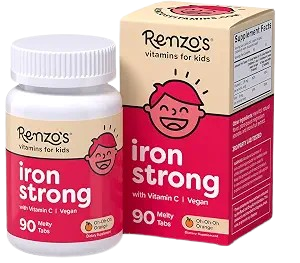
Renzo's - Iron Strong
A dissolvable tablet that melts on the tongue, using carbonyl iron for a strong safety profile and good taste acceptance.
- Elemental iron9 mg per tablet
- Formcarbonyl iron
- Also containsvitamin C (ascorbic acid)
- Formatdissolvable tab, Oh-Oh-Orange flavor
- Free fromgluten, sugar, artificial colors
- your child refuses to chew tablets or swallow liquids
- you want a safer iron form (carbonyl)
- your child is between 2 and 8
- your child needs a higher therapeutic dose
- you prefer a liquid for a baby under 2
Renzo's Iron Strong uses carbonyl iron, a form that a randomized trial in young children found to be as effective as ferrous sulfate with significantly fewer side effects. The tablet dissolves on the tongue in about 30 seconds, which sidesteps the chewing and swallowing battles that many parents dread. Each tablet provides 9 mg of elemental iron, landing neatly between the RDA for ages 1 to 3 (7 mg) and ages 4 to 8 (10 mg).
Vitamin C is included to support iron absorption. The product is made in an NSF-certified facility and is labeled vegan, sugar-free, and non-GMO. Parents report the orange flavor goes over well with most children. We docked a small amount on value because the pack lasts about 45 days at one tablet per day for younger children but only about 22 days if an older child takes the two-tablet serving.
Where to buy
Prices change often, so we don't show them here: check the retailer for today's price.
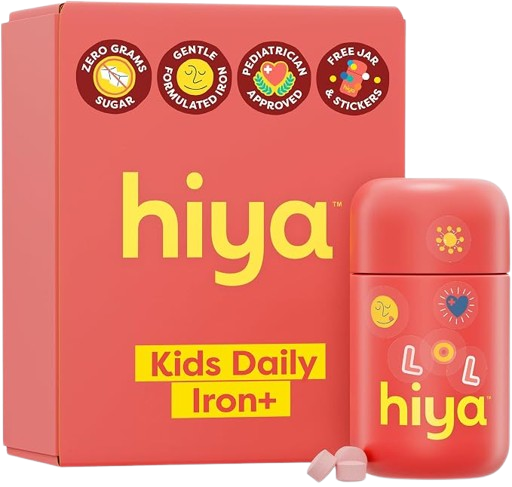
Hiya - Kids Daily Iron+
A third-party certified chewable with carbonyl iron and whole-food vitamin C from acerola cherry, and nothing artificial on the label.
- Elemental iron7 mg per tablet
- Formcarbonyl iron
- Also containsvitamin C from acerola cherry & sodium ascorbate
- Formatchewable tablet
- Free fromsugar, gluten, dairy, GMOs
- you want the cleanest possible label
- your child is 1 to 3 and you want a dose that matches the exact RDA
- a third-party certification matters to you
- your child needs more than 7 mg per dose
- you prefer a liquid format
Hiya stands out for ingredient transparency. The 7 mg of carbonyl iron matches the exact NIH RDA for children aged 1 to 3, and the vitamin C comes from whole-food acerola cherry rather than synthetic ascorbic acid alone. Sweetness is from monk fruit extract, the coloring is from beetroot, and the tablets are third-party certified for purity. There are no gummy coatings, no added sugars, and no artificial anything.
On Thingtesting, the product holds a 4.9 out of 5 rating across its reviews, with parents noting that kids "ask for more after their daily dose" (Thingtesting, verified buyer). The main limitation is the dose: at 7 mg, it falls short of the 10 mg RDA for ages 4 to 8, so older children relying on it alone would need additional dietary iron. The subscription-only model and higher price per tablet compared with simpler brands pulled the value score down to 7.5.
Where to buy
Prices change often, so we don't show them here: check the retailer for today's price.
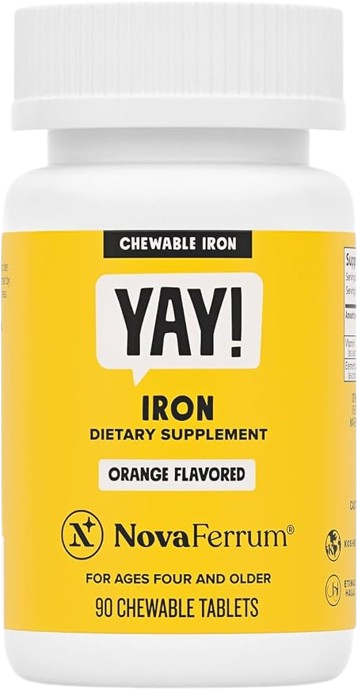
NovaFerrum - YAY! Chewable
An 18 mg polysaccharide iron complex chewable designed for children aged 4 and up who need a bigger dose under medical guidance.
- Elemental iron18 mg per tablet
- Formpolysaccharide iron complex
- Also containsvitamin C (ascorbic acid)
- Formatchewable tablet, 90 per bottle
- Free fromgluten, sugar, artificial colors
- your pediatrician recommends a higher iron dose
- your child is 4+ with confirmed low iron
- you want the clinical-grade PIC form in a chewable
- your child is under 4
- your child does not have a diagnosed deficiency (18 mg may be more than needed)
NovaFerrum YAY! delivers 18 mg of elemental iron per tablet using the same polysaccharide iron complex found in the brand's prescription-grade pediatric drops. That puts it well above the standard RDA for ages 4 to 8 (10 mg) and 9 to 13 (8 mg), which is why this supplement is best suited to children whose pediatrician has recommended catch-up dosing after a blood test. The bottle holds 90 tablets, giving a three-month supply at one tablet daily.
The chewable is labeled vegan, kosher, halal, and sugar-free. Tolerance scored 7.5 rather than higher because 18 mg is a substantial dose and some parents report occasional constipation or stomach discomfort at this level. Buyer feedback is solid but less abundant than for the other products on this list, which is reflected in the 7.5 sub-score.
Where to buy
Prices change often, so we don't show them here: check the retailer for today's price.
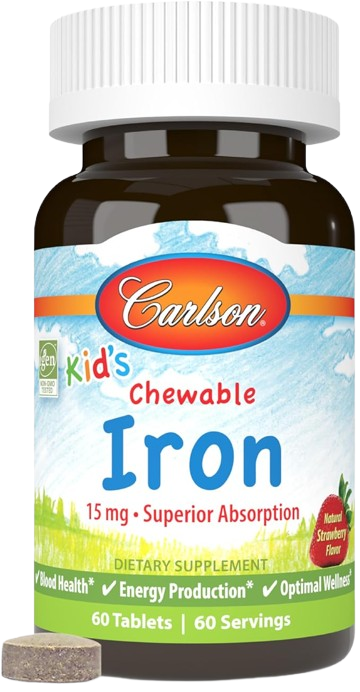
Carlson - Kids Chewable Iron
A chelated iron bisglycinate chewable at 15 mg, known for gentle absorption and a well-liked strawberry flavor.
- Elemental iron15 mg per tablet (from iron glycinate)
- Formiron bisglycinate (chelated)
- Formatchewable tablet, strawberry flavor
- Serving1 tablet daily
- your child has a sensitive stomach and other forms cause cramps
- you want a chelated iron that absorbs without competing with calcium
- your child likes strawberry
- your child is under 4
- you prefer a lower dose closer to the standard RDA
Carlson uses iron bisglycinate, a chelated form where the iron is bonded to glycine. Chelated iron is absorbed through a different pathway than ferrous salts, which means it is less likely to compete with calcium or cause the metallic taste and nausea associated with ferrous sulfate. Each tablet delivers 15 mg of elemental iron, suitable for children 4 and up, particularly those in the 9-to-13 age bracket where 8 mg is the RDA and a small buffer can help if dietary intake is inconsistent.
The strawberry flavor is straightforward and most parents say their children eat it without fuss. The ingredient list is shorter than most competitors, though it does include sugar and fructose as sweeteners, which may not suit parents looking for a sugar-free option. Buyer feedback is positive but the product has fewer reviews overall than carbonyl iron and PIC competitors, pulling that sub-score to 7.5.
Where to buy
Prices change often, so we don't show them here: check the retailer for today's price.
When to skip supplements and talk to your pediatrician
Iron supplements are not always the answer, and more iron is not always better. There are several situations where a conversation with your child’s doctor should come before any supplement.
Your child is under 1 year old (breast milk and formula are the primary iron sources, and supplementation should only follow medical advice). Your child has a chronic condition affecting iron metabolism (thalassemia, sickle cell disease, inflammatory bowel disease). Your child is taking any prescription medication, especially antacids, thyroid medication, or antibiotics, which can interact with iron (NIH). You notice persistent fatigue, pale skin, brittle nails, or unusual cravings for non-food items (pica), which may indicate a level of deficiency that needs prescription-strength treatment and monitoring.
A simple blood test measuring ferritin, serum iron, and complete blood count is the only reliable way to confirm whether your child is iron deficient. The American Academy of Pediatrics recommends screening for anemia at around 12 months of age, with additional screening for children at higher risk.
Questions parents ask
How much iron does my child need each day?
It depends on age. The NIH sets the RDA at 7 mg for ages 1 to 3, 10 mg for ages 4 to 8, and 8 mg for ages 9 to 13. Babies aged 7 to 12 months need 11 mg daily. These figures include iron from food and supplements combined, so if your child eats iron-rich foods regularly, they may not need a full-dose supplement.
Can I give my toddler an adult iron supplement?
No. Adult iron supplements typically contain 18 to 65 mg of elemental iron per dose, which is well above the 40 mg upper limit for children under 14 (NIH). An accidental overdose of iron is a leading cause of poisoning in children under 6. Always use a supplement formulated for your child's age group.
Do iron supplements stain children's teeth?
Liquid iron supplements can leave a temporary grayish-brown stain on teeth, especially if the drops sit on the enamel. To reduce staining, place the drops toward the back of the mouth using the dropper, follow with water, and brush teeth afterward. Chewable and dissolvable tablets are less likely to stain because they spend less time in direct contact with teeth.
How long does it take for iron supplements to work in kids?
If your child has iron deficiency anemia, hemoglobin levels usually begin to rise within 2 to 4 weeks of starting supplementation. Ferritin stores take longer to rebuild, often 3 to 6 months of consistent use. Your pediatrician will typically recheck blood work after about 4 to 8 weeks to confirm the supplement is working.
Is carbonyl iron really safer than ferrous sulfate for kids?
Carbonyl iron has a lower acute toxicity risk because it requires stomach acid to be absorbed, which limits how much enters the bloodstream at once. A randomized trial in children under six found that carbonyl iron caused no vomiting, compared with 36% in the ferrous sulfate group, and was equally effective at raising hemoglobin. However, "safer in overdose" does not mean safe: all iron products must be kept out of children's reach.
The bottom line
The best iron supplement for your child depends on their age, the form of iron they tolerate, and whether a pediatrician has flagged a specific deficiency. For most families, a gentle form like polysaccharide iron complex or carbonyl iron will do the job without the stomach upset that ferrous salts often bring. Start with a dose that matches the NIH RDA for your child’s age group, give it alongside vitamin C, and keep the bottle locked away.
NovaFerrum - Yummy Pediatric Drops
- Polysaccharide iron complex, the same form used in prescription pediatric drops
- 15 mg per mL with a calibrated dropper for precise dosing
- Sugar-free, vegan, kosher, halal, and free from common allergens

Independent guides to natural remedies and supplements, checked against NHS and EFSA references.